Spine Disease Classification & Biomechanical Diagnostic Platform
تفاصيل العمل
1 Job Title & Purpose
Job Title: Medical AI / ML Engineer (Biomechanical Diagnostic Specialist)
Core Purpose: To design, develop, and evaluate a predictive machine learning pipeline that classifies spinal diseases and analyzes pelvic/lumbar biomechanical features to assist clinicians with accurate, early diagnoses
2 Key Responsibilities
Data Preprocessing & Feature Engineering:
Clean and structure biomedical datasets, focusing on key physical parameters (e.g., grade of spondylolisthesis, pelvic radius, lumbar lordosis angle)
Handle missing values and address class imbalances between healthy (Normal) and pathological (Abnormal) cases
Model Development & Training:
Implement and train a Random Forest Classifier to distinguish between normal and abnormal biomechanical profiles
Perform hyperparameter tuning to optimize performance metrics while minimizing model overfitting
Diagnostic Evaluation & Performance Analysis:
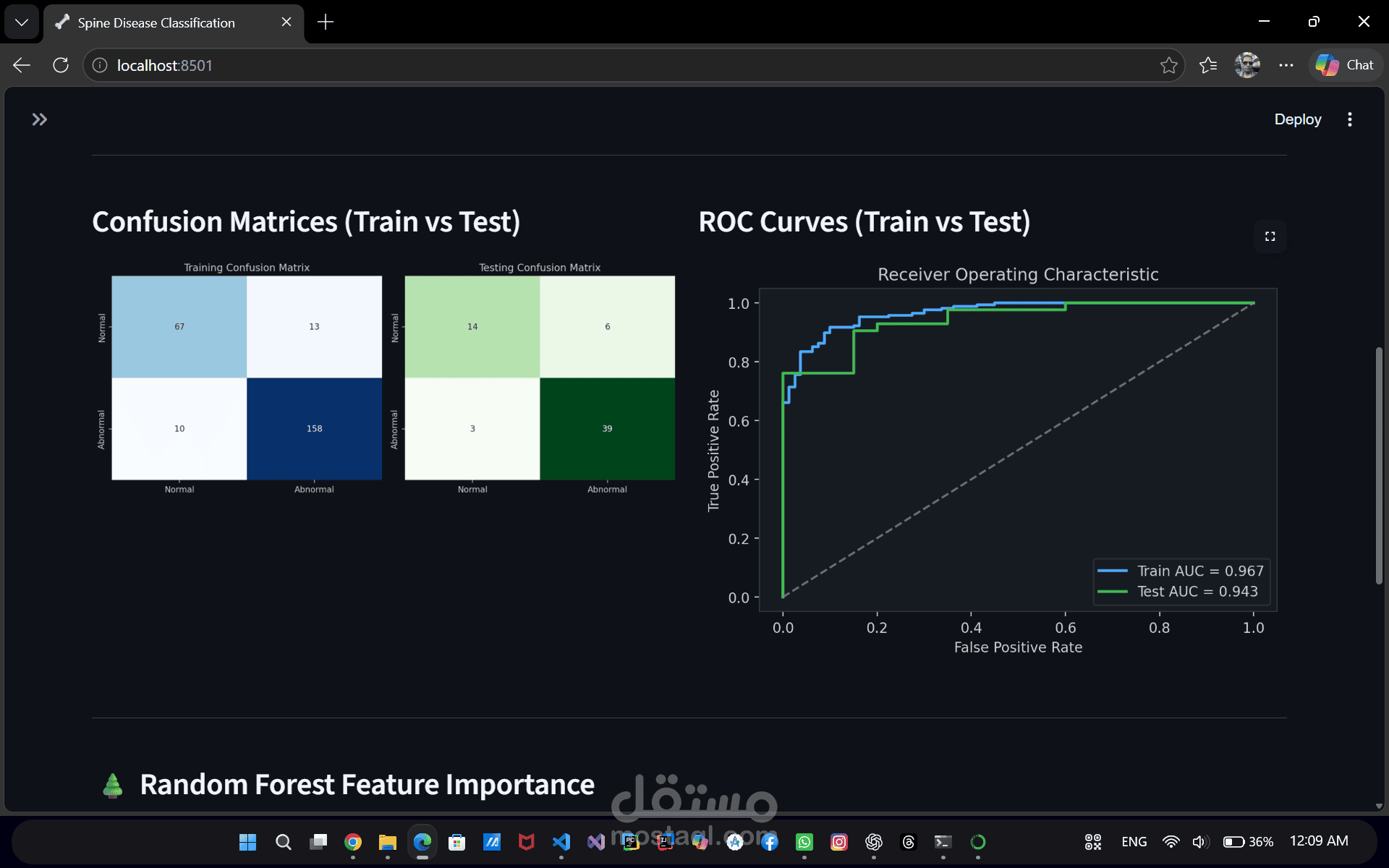
Assess model performance across train and test sets using standard evaluation metrics (Accuracy, Precision, Recall, F1-Score, and ROC-AUC)
Generate and analyze confusion matrices to minimize critical diagnostic errors (False Positives and False Negatives)
Conduct Feature Importance Analysis to rank clinical predictors and provide interpretable insights for medical practitioners
Documentation & Reporting:
Prepare technical and clinical evaluation reports detailing the model's reliability and readiness for deployment
Deliver bilingual summaries (Arabic/English) for cross-functional stakeholders and healthcare teams
3 Key Performance Indicators (KPIs)
Test Accuracy: Achieve a minimum accuracy threshold of 90% (Achieved: 91.9%)
ROC-AUC Score: Maintain strong class discrimination ability above 0.90 (Achieved: 0.955)
Sensitivity / Recall: Keep missed pathological cases to a minimum (Achieved: 95.2%)