تحليل بيانات لمبيعات سوبرماركت
تفاصيل العمل
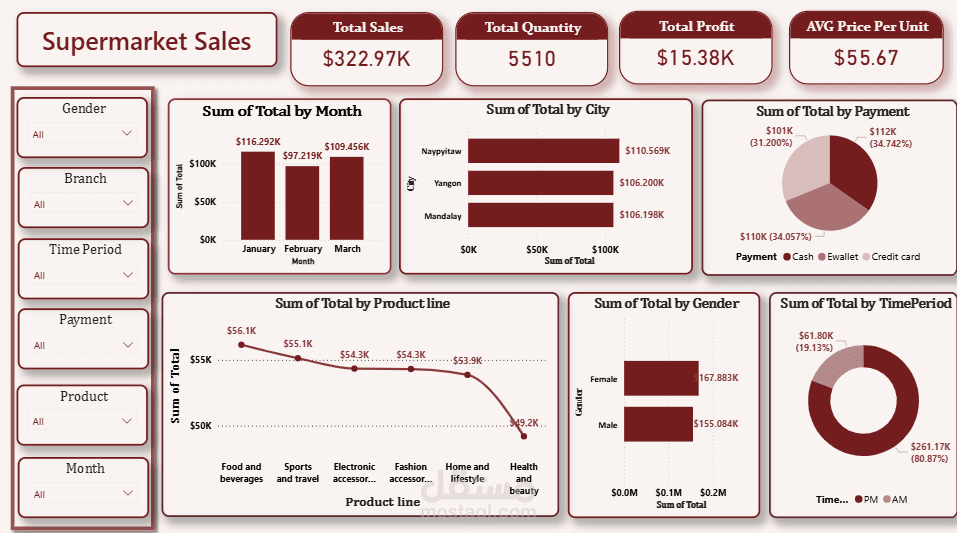
Supermarket Sales Dashboard – Data Analysis Project
In this project, I worked on analyzing and visualizing supermarket sales data to provide clear insights into sales performance and customer behavior.
1. Data Cleaning & Preparation
I started by cleaning and preparing the raw dataset to ensure accuracy and consistency. This included:
Removing duplicate and missing values.
Correcting data types (dates, numerical values, and categorical fields).
Standardizing column names and categories such as payment methods, product lines, and branches.
Verifying calculations for total sales, quantity, and profit.
This step ensured the data was reliable and ready for analysis.
2. Data Modeling & KPIs
After cleaning the data, I created key performance indicators (KPIs) to summarize business performance:
Total Sales
Total Quantity Sold
Total Profit
Average Price per Unit
These KPIs provide a quick overview of the supermarket’s overall performance.
3. Interactive Dashboard Design
I then built an interactive dashboard to visualize the data and make insights easy to explore. The dashboard includes:
Sales by Month:
A column chart showing total sales for January, February, and March to identify monthly trends.
Sales by City:
A bar chart comparing sales performance across different cities (Yangon, Mandalay, Naypyitaw).
Sales by Product Line:
A line chart highlighting how different product categories contribute to total sales.
Sales by Gender:
A comparison of total sales generated by male and female customers.
Sales by Payment Method:
A pie chart showing the distribution of sales across Cash, E-wallet, and Credit Card payments.
Sales by Time Period:
A donut chart comparing sales during AM and PM periods.
4. Filters & Interactivity
To enhance usability, I added interactive filters that allow users to analyze the data dynamically:
Gender
Branch
Time Period
Payment Method
Product Line
Month
These slicers enable users to drill down into specific segments and answer business questions easily.
5. Business Insights
The dashboard helps stakeholders:
Identify top-performing months, cities, and product lines.
Understand customer purchasing behavior by gender and payment method.
Analyze peak sales times and optimize operations accordingly.