Advanced Blog Application Using Django
تفاصيل العمل
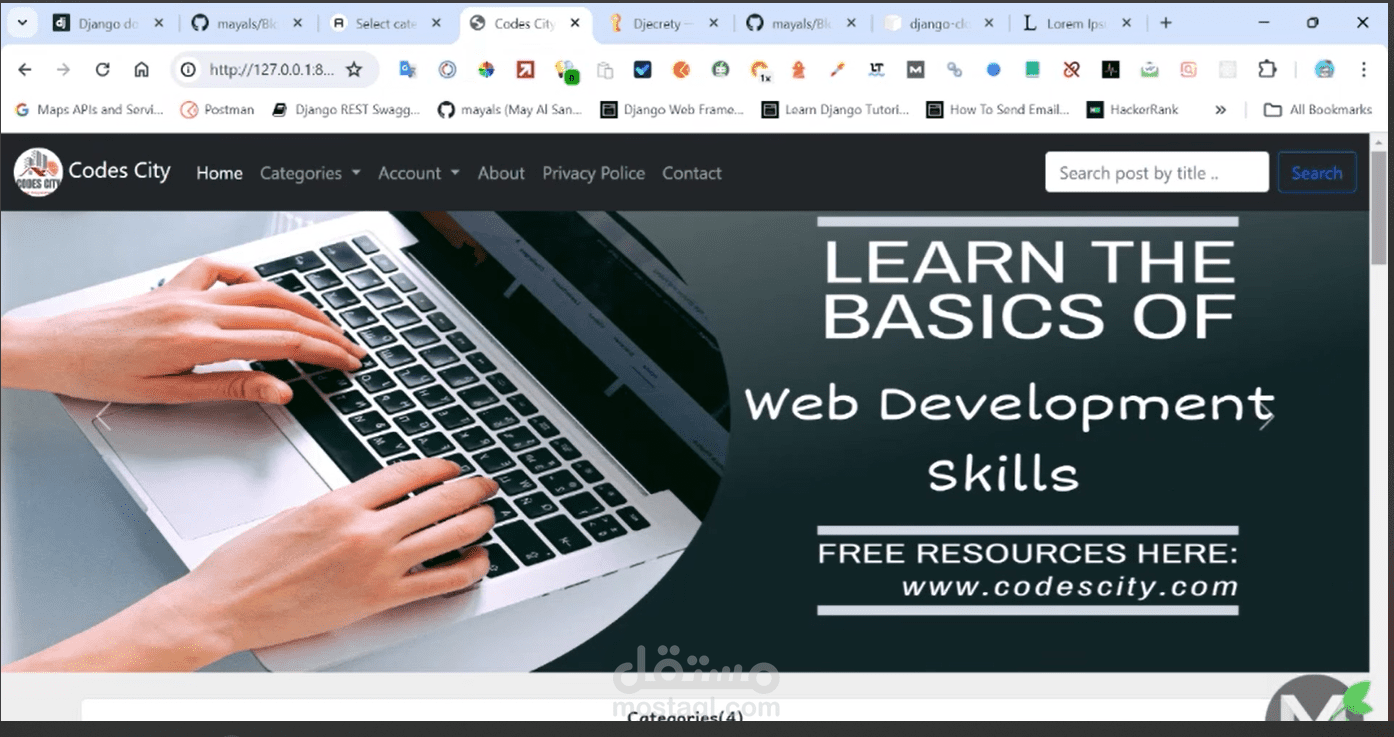
Project Overview
This Django-based blog application is a feature-rich platform designed with advanced functionalities for seamless content management and user interaction. The application provides essential blogging capabilities, including CRUD operations, search, filtering, and hashtag tagging for articles. It also incorporates robust role-based permissions to ensure secure access.
The application is developed with modern tools and libraries, leveraging Django’s built-in features and third-party integrations for an efficient and visually appealing user experience.
Core Features
Blog CRUD Operations:
Add, Edit, and Delete Post: Empower authorized users to manage blog content effectively.
Post List Page: Displays articles with pagination for easy browsing.
Post Detail Page: Provides an in-depth view of individual articles, including content and hashtags.
Advanced Features:
Search Functionality: Quickly find posts using keywords.
Filtering: Narrow down articles by categories, dates, or other criteria.
Hashtag Integration: Allows tagging articles for better categorization and improved discoverability.
User Roles and Permissions:
Role-Based Access Control: Secure the application by assigning different access levels to users (e.g., admins vs. regular users).
Privacy Management: Restrict articles or sections of the site based on user permissions.
Reusable Templates and Styling:
Implements a base.html template to standardize layouts across pages and reduce redundant code.
Uses Bootstrap 4 for responsive and modern styling.
Dynamic Media and Static File Management:
Utilizes Cloudinary for storing and serving media files efficiently.
Ensures streamlined static file handling with Django’s staticfiles and Cloudinary integrations.
Responsive Design:
Delivers a user-friendly interface across devices, thanks to responsive frameworks like Bootstrap and custom CSS.
Technologies and Dependencies
Backend
Django Framework: For robust backend functionality. (Django==4.2.10).
Django Templates: For dynamic rendering with reusable template blocks.
PostgreSQL: A powerful, scalable database for storing application data, configured via psycopg2.
Frontend
Bootstrap 5: For responsive design. (django-bootstrap-v5==1.0.11)
FontAwesome: Adds icons for enhanced visuals.(fontawesomefree==6.5.1)
Crispy Forms with Bootstrap 5: Simplifies and styles forms.(django-crispy-forms==2.1)
Third-Party Integrations
Cloudinary: For media storage and serving.
Django-CKEditor 6: Enhances the text editor for rich-text content.(django-ckeditor==6.7.0)
Django-Phonenumber-Field: Provides robust handling for phone numbers.(phonenumbers==8.13.27)
Django-Countries: Adds country selection functionality.(django-countries==7.5.1)
Jazzmin: Customizes the Django admin interface for better usability.(django-jazzmin==2.6.0)
Database Configuration
The application uses PostgreSQL for storing and managing data, configured through the environment .variables for security and flexibility
the project consists of 3 applications:
1 - Blog application - deals with managing blogs data and functionalities for post creating, updating, deleting, and retrieving. The interaction of the post with another system, for organization and easy to reach or adding actions, needs to relation to categories, tags, authors and Comment. We need relations with the users who write the post and the users how review and rate the posts , like the post, share the post and add comments to seclected post .
The blog application consists of 4 tables in the database, Category, Tag, Post and Comment.
2- User application - deals with users of the projects, starting from admin to normal customers of the blog, authentication, Register, login, logout. also users' profiles, creating, updating, deleting, and retrieving. permit user according to the type of user, Admin, or normal user(customer) also in this application the user can share any post to another person by email, can like the post that find it good to like it .Also there is a profile for each user in the blog, the request user can update his profile only and have no permission to view some sentisive data in other profile or edit another profile.
3 - Pges application - deal with pages that any website required , contactus , about us , thank you ,privacy-police, anf other pages.
In general, each application consists of a urls.py file that contains the URL patterns of the paths to views in the views.py file, I have a function based view.
. A model in Django is a Python class that defines the structure of a database table. It specifies the fields and behaviors of the data you want to store. Django's ORM (Object-Relational Mapping) allows you to interact with the database using these models instead of writing raw SQL queries. In the Blog application, I have models of (Category, Tag, Post).In the user application, I have models of (UserModel, Profile,SMSCode). with using many types of fields (CharField,IntegerField,DecimalField,BooleanField,DateTimeField,EmailField,ImageField,OneToOneField,ManyToManyField). in forms.py files, there is a files deal with input data to data base by form ,that need error validation before insert it in database in order to prevent error s and problems in database.
Target Audience
This application is ideal for individuals or organizations seeking a feature-rich blogging platform with scalability and a modern user experience. It’s especially suited for writers, content creators, or businesses aiming to manage and share content efficiently.
Level of Complexity
The project is of intermediate complexity, showcasing effective use of Django’s core features along with advanced integrations like Cloudinary, CKEditor, and PostgreSQL. The combination of reusable templates, robust database configuration, and third-party tools ensures a scalable and maintainable solution.