Design Tensile
تفاصيل العمل
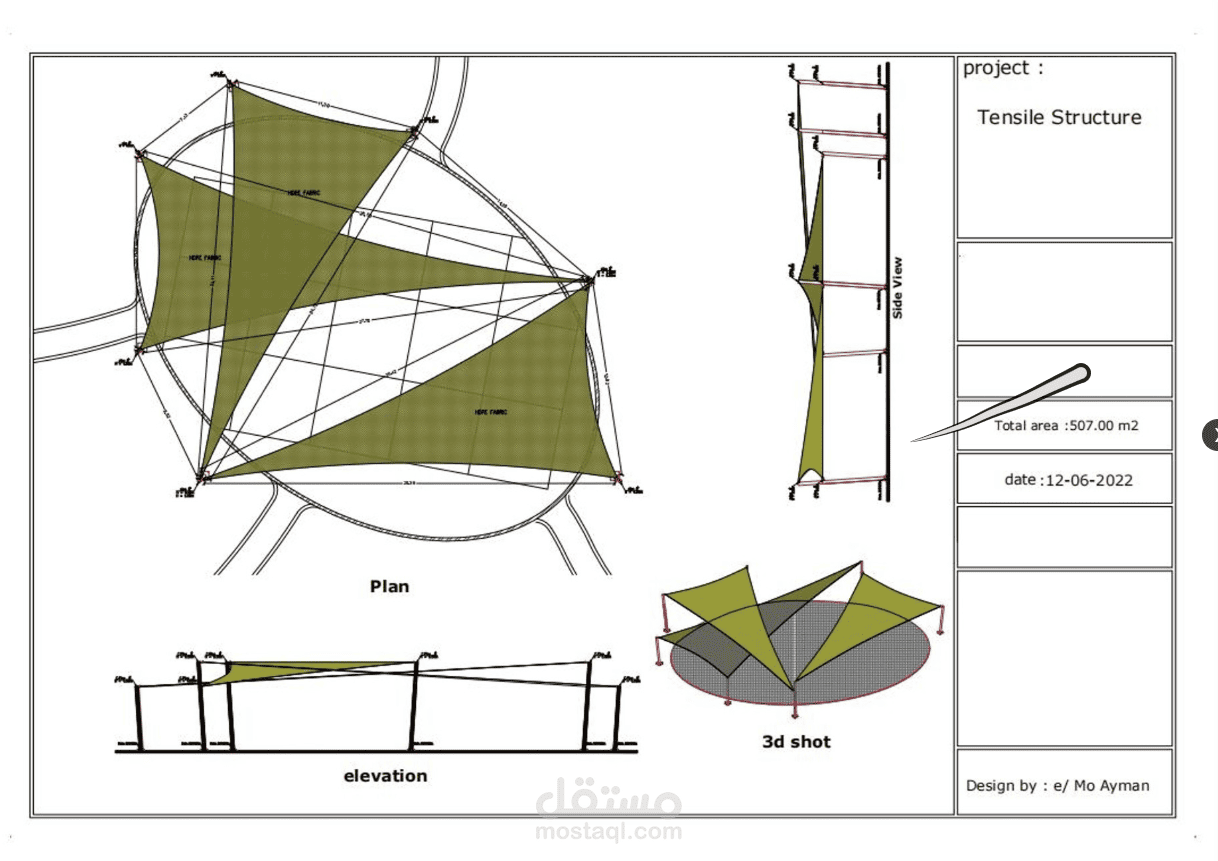
Designing tensile structures isn't just about aesthetics; it's about mastering wind behavior. 🌪️
I recently completed the structural analysis and connection design for the "Al Jawhara" Tensile Canopy (Total Area: 507 m²), and I’m excited to share the workflow.
📌 System & Tools:
• 3D Steel Pipe framework (A36).
• Analysis: SAP2000 (AISC-ASD89).
• Connection Design: RAM Connection.
💡 The Engineering Challenge:
For tensile canopies, wind uplift (suction) is usually the governing load case, not gravity. The critical part of this project was accurately mapping lateral loads as Area Surface Pressures across the complex, inclined membrane geometries to simulate real-world uplift forces.
✅ The Outcome:
The structure passed all capacity checks with highly optimized sections:
• Main frame pipes verified safely under critical load combinations.
• Base plate connections (M12 anchors on C25-30 concrete pedestals) designed and verified with an impressive 0.09 utilization ratio.
I’ve attached a quick document summarizing the layouts, SAP2000 uplift modeling, and RAM Connection design checks. Check it out below! 👇
I’d love to hear from my fellow structural engineers: How do you usually handle complex wind uplift mapping on non-standard geometries? Let me know in the comments!