bank system
تفاصيل العمل
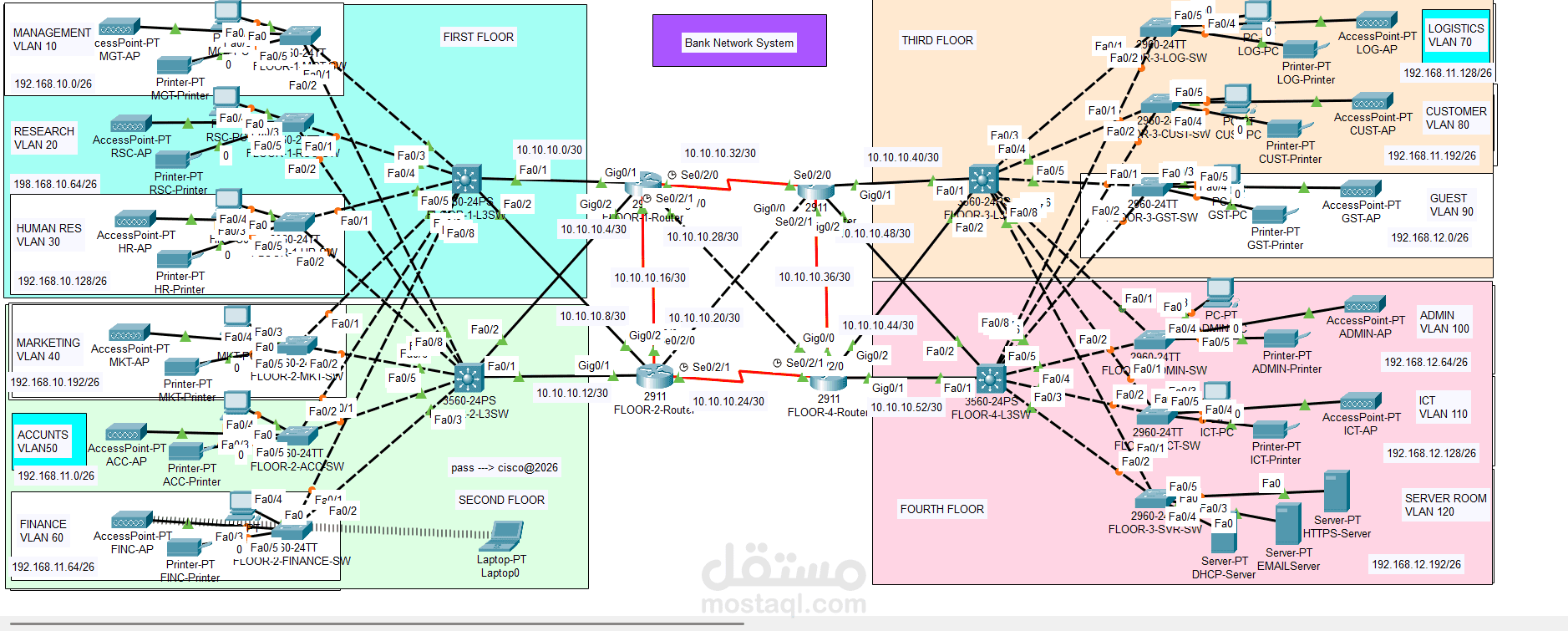
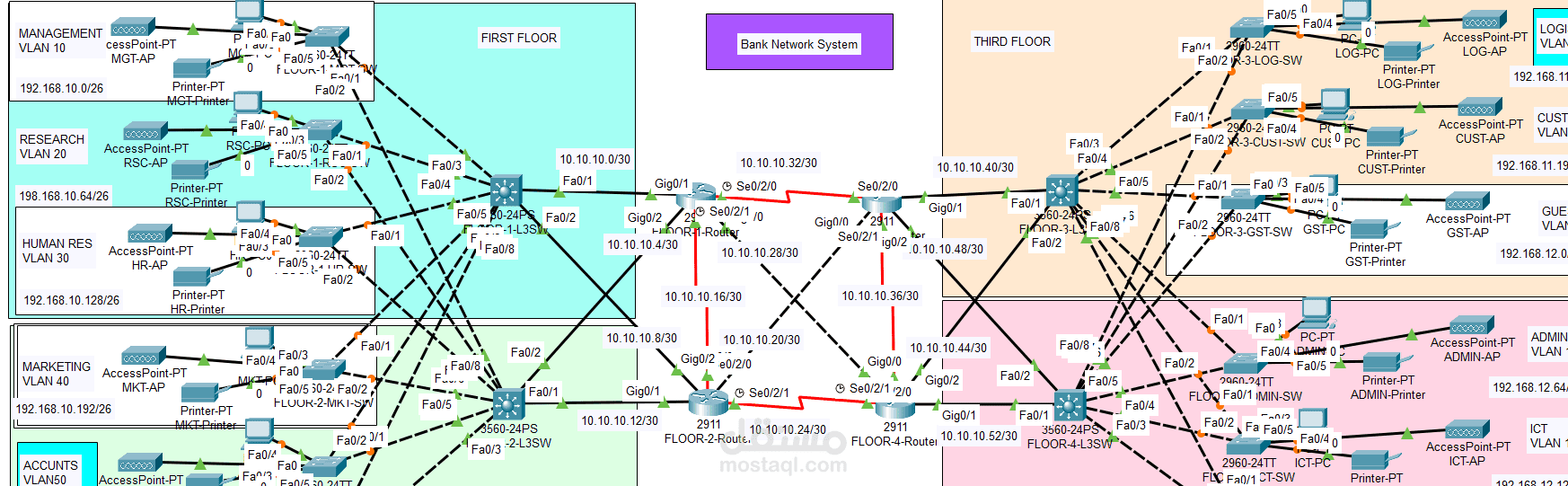
Bank Network System: Multi-Floor Enterprise Network Design
Tool: Cisco Packet Tracer
Overview
A full network design for a four-story bank building. Each floor has its own Layer 3 switch and is split into isolated departmental VLANs. Floors are interconnected through a routed core built on Cisco 2911 routers, with redundant links between layers. The design covers segmentation, scalable IP addressing, wireless access, and centralized server services.
Network Architecture
Access layer: Cisco 2960-24TT switches, one per department, connecting PCs, printers, and wireless access points.
Distribution layer: One Cisco 3560-24PS multilayer switch per floor, handling inter-VLAN routing for the departments on that floor.
Core / WAN layer: Cisco 2911 routers linked by serial connections, with every point-to-point link addressed on its own /30 subnet.
Redundancy: Dual cross-connections between the floor switches and routers, so a single link failure doesn't isolate a floor.
Floor and VLAN Layout
Floor Department VLAN Subnet
1 Management 10 192.168.10.0/26
1 Research 20 192.168.10.64/26
1 Human Resources 30 192.168.10.128/26
2 Marketing 40 192.168.10.192/26
2 Accounts 50 192.168.11.0/26
2 Finance 60 192.168.11.64/26
3 Logistics 70 192.168.11.128/26
3 Customer Service 80 192.168.11.192/26
3 Guest 90 192.168.12.0/26
4 Admin 100 192.168.12.64/26
4 ICT 110 192.168.12.128/26
4 Server Room 120 192.168.12.192/26
Key Design Decisions
Segmentation: 12 VLANs, one per department, keep traffic separated. The Guest network is isolated from internal bank resources.
Efficient addressing: The 192.168.10.0/24 to 192.168.12.0/24 range is divided into /26 subnets (62 usable hosts each), and router links use /30 subnets from the 10.10.10.0/24 range.
Centralized services: The Server Room hosts a DHCP server, an HTTPS web server, and an email server, serving all floors.
Wireless coverage: Every department has its own access point, and the Finance department also includes a wireless laptop.
Skills Demonstrated
VLAN design, inter-VLAN routing, VLSM/subnetting, multilayer switching, router-to-router connectivity, DHCP services, redundant network design, and network documentation.