PWM Generation Function
تفاصيل العمل
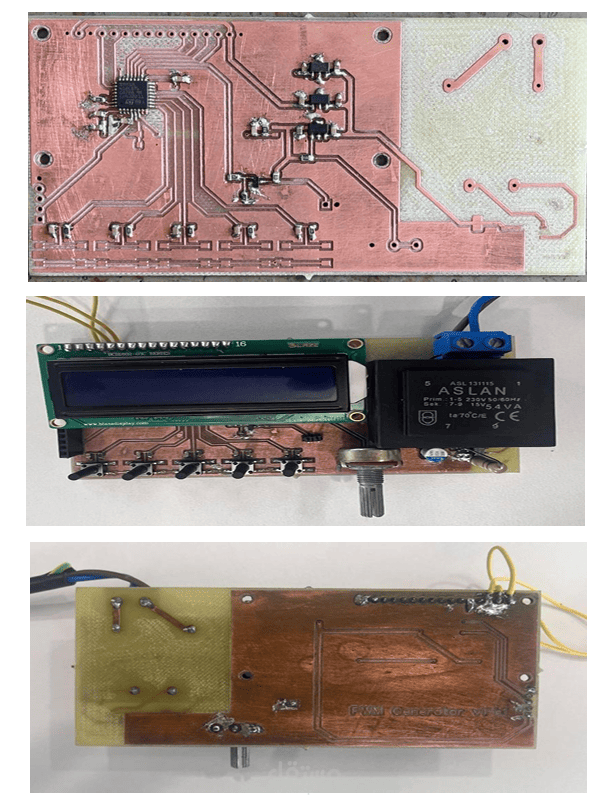
Embedded systems play a crucial role in modern electrical and electronic engineering, as
they combine hardware and software to perform dedicated functions with high efficiency and
reliability. Microcontroller-based systems are widely employed in industrial control,
communication systems, medical devices, and educational laboratories. Among these applications,
signal generators represent an essential tool used for testing, debugging, and analyzing electronic
circuits.
This research presents the design and implementation of a microcontroller-based function
generator using an STM32 microcontroller. The system is capable of generating Pulse Width
Modulation (PWM) signals as well as analog waveforms such as sinusoidal and triangular signals.
The generated signals can be controlled in terms of frequency and duty cycle through a simple user
interface consisting of push buttons and a Liquid Crystal Display (LCD).
The project focuses on the complete development cycle of an embedded electronic system,
including requirement analysis, hardware design, schematic capture, printed circuit board (PCB)
design and fabrication, embedded software development, system integration, testing, and
performance optimization. The final outcome demonstrates a practical and educational signal
generator suitable for laboratory and research applications.