Household-Electric-Power-Consumption-Prediction-using-Machine-Learning
تفاصيل العمل
⚡ Household Electric Power Consumption Prediction
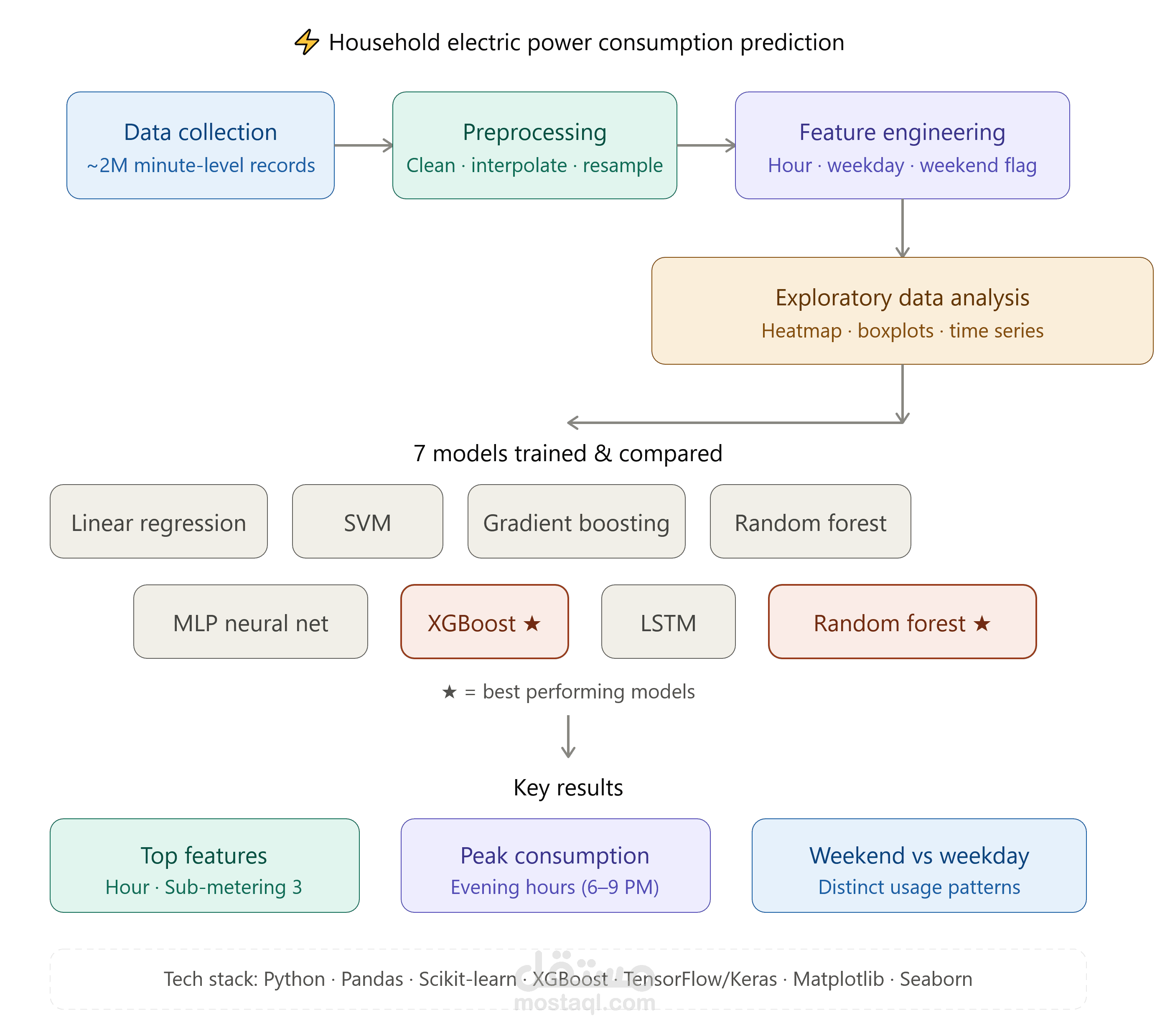
A complete end-to-end machine learning project that analyzes and predicts household electricity consumption using real-world time series data. Seven models are trained, evaluated, and compared to find the best predictor.
📌 Project Overview
This project covers the full data science pipeline — from raw data cleaning to model deployment-ready predictions — using the UCI Household Power Consumption dataset recorded at one-minute intervals over nearly 4 years.
🔄 Pipeline
Raw Data → Cleaning → Feature Engineering → EDA → Modeling → Evaluation → Insights
📊 Dataset
Source: UCI Machine Learning Repository — Individual Household Electric Power Consumption
Size: ~2 million minute-level records
Target: Global_active_power (kW)
Features: Voltage, Global reactive power, Sub-metering 1/2/3, date/time
🛠️ What's Inside
1. Data Preprocessing
Parsed datetime index from Date + Time columns
Time-based interpolation for missing values
Resampled from minute-level to hourly averages
Removed duplicates and statistical outliers (IQR method)
2. Feature Engineering
Extracted: hour, day_of_week, month, year, is_weekend
Normalized features using MinMaxScaler
3. Exploratory Data Analysis
Time series trends
Correlation heatmap
Consumption by hour, weekday, and month (boxplots)
Distribution histogram with outlier visualization
4. Models Trained
Model Type
Linear Regression Baseline
Support Vector Machine (SVR) Kernel-based
Gradient Boosting Ensemble
Random Forest Ensemble
MLP Neural Network Deep Learning
XGBoost Boosting
LSTM Recurrent Neural Network
5. Evaluation Metrics
RMSE (Root Mean Squared Error)
R² Score
MAE (Mean Absolute Error)
Training Time
📈 Key Results
✅ Best models: XGBoost & Random Forest (highest R², lowest RMSE)
🕐 Most important features: Hour of day, Sub-metering 3
🌙 Peak consumption: Evening hours (6–9 PM)
📅 Weekend patterns differ significantly from weekdays
🧰 Tech Stack
Library Purpose
Pandas / NumPy Data manipulation
Scikit-learn ML models & preprocessing
XGBoost Gradient boosting
TensorFlow / Keras LSTM model
Matplotlib / Seaborn Visualization