Raspberry Pi-Based Real-Time Monitoring and Control System with PLC Interface
تفاصيل العمل
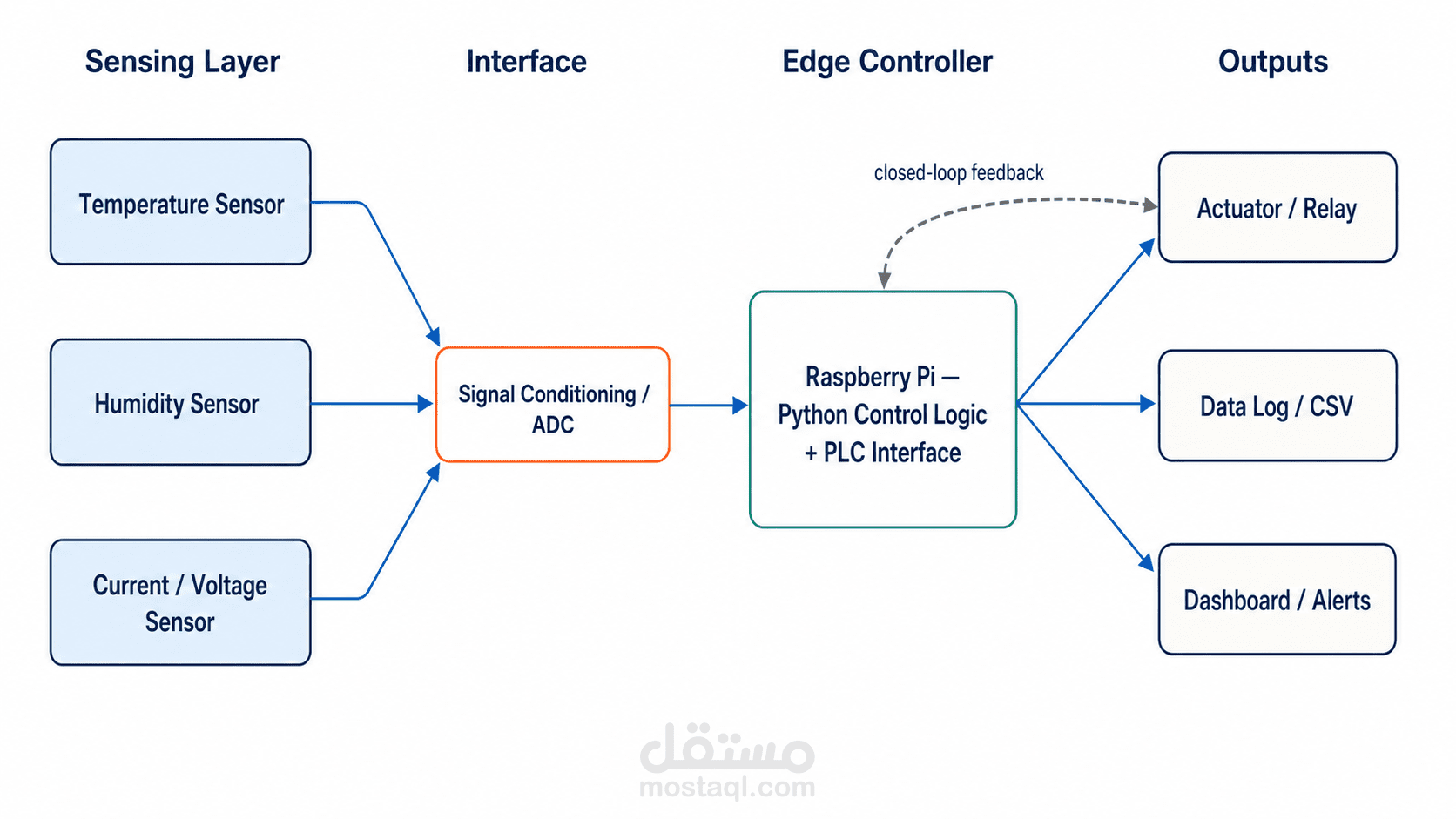
This project covered the end-to-end design and implementation of an embedded monitoring and control system built around a Raspberry Pi single-board computer. The system continuously acquires data from physical sensors, processes it on the edge device, and drives automated control actions, with an optional interface to a programmable logic controller for integration into industrial environments.
The design proceeded in clearly defined layers. In the sensing layer, temperature, humidity and current or voltage sensors were selected according to the measurement range and accuracy required. The interface layer handled signal conditioning and analogue-to-digital conversion so that low-level analogue signals were converted into clean digital readings suitable for the controller. Schematic capture and wiring diagrams were prepared to document the electrical connections and to ensure safe, repeatable assembly.
At the edge-controller layer, control logic was implemented in Python on the Raspberry Pi. The software polls the sensors at a defined sampling interval, applies threshold and filtering logic, logs the readings, and issues commands to actuators or relays through a closed feedback loop so that the system responds automatically to changing conditions. Where industrial deployment was required, the architecture exposes a PLC interface so that the same logic can interoperate with existing plant control hardware.
Outputs from the system include actuator control signals, a time-stamped data log in CSV format for later analysis, and a lightweight dashboard with alert notifications. Deliverables comprised the circuit design and wiring diagram, the documented control software, a working hardware prototype, and an operating manual describing setup, calibration and routine use. Tools and methods: Raspberry Pi, Python, GPIO and ADC interfacing, sensor integration, PLC ladder logic, schematic design.