Machine Learning Surrogate Model for Engineering Data Analysis and Parameter Optimization
تفاصيل العمل
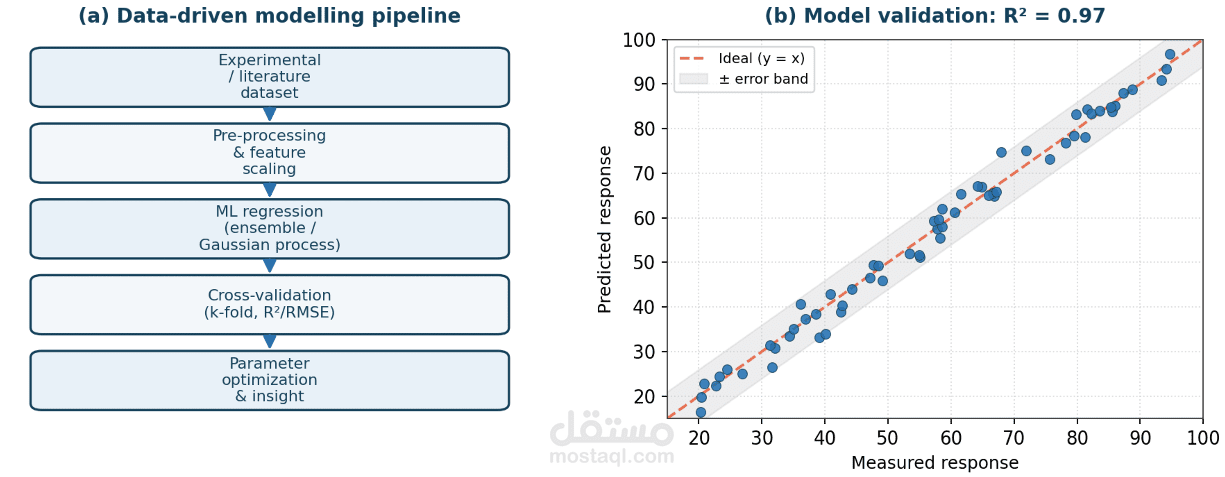
This project delivered a complete data-driven analysis and optimization workflow for an engineering system whose performance depends on several coupled input parameters. The objective was to replace expensive physical or numerical experiments with a fast, accurate predictive model, and then use that model to locate the parameter combination that maximizes performance.
The work began with assembly and curation of the dataset, drawn from experimental measurements and the published literature. Data cleaning addressed missing entries, outliers and inconsistent units, after which the input features were normalized so that variables of different physical magnitude contributed proportionately during training. The processed dataset was then partitioned for training and testing.
Several regression algorithms were evaluated, including tree-based ensemble methods and a Gaussian-process (Kriging) surrogate, the latter being well suited to smooth engineering response surfaces and to quantifying prediction uncertainty. Model accuracy was assessed using k-fold cross-validation with the coefficient of determination and the root-mean-square error as performance metrics. The final model achieved close agreement between predicted and measured responses, as shown by the parity plot in which the data cluster tightly along the ideal line.
The validated surrogate was finally coupled to an optimization routine to identify the operating parameters that yield the best response, substantially reducing the number of physical trials required. Deliverables comprised the documented analysis code, the trained and validated model, the result visualizations, and a concise technical report describing the methodology, assumptions and findings. Tools and methods: Python, scikit-learn, ensemble regression, Gaussian-process surrogate, k-fold cross-validation.