Enterprise Network Infrastructure
تفاصيل العمل
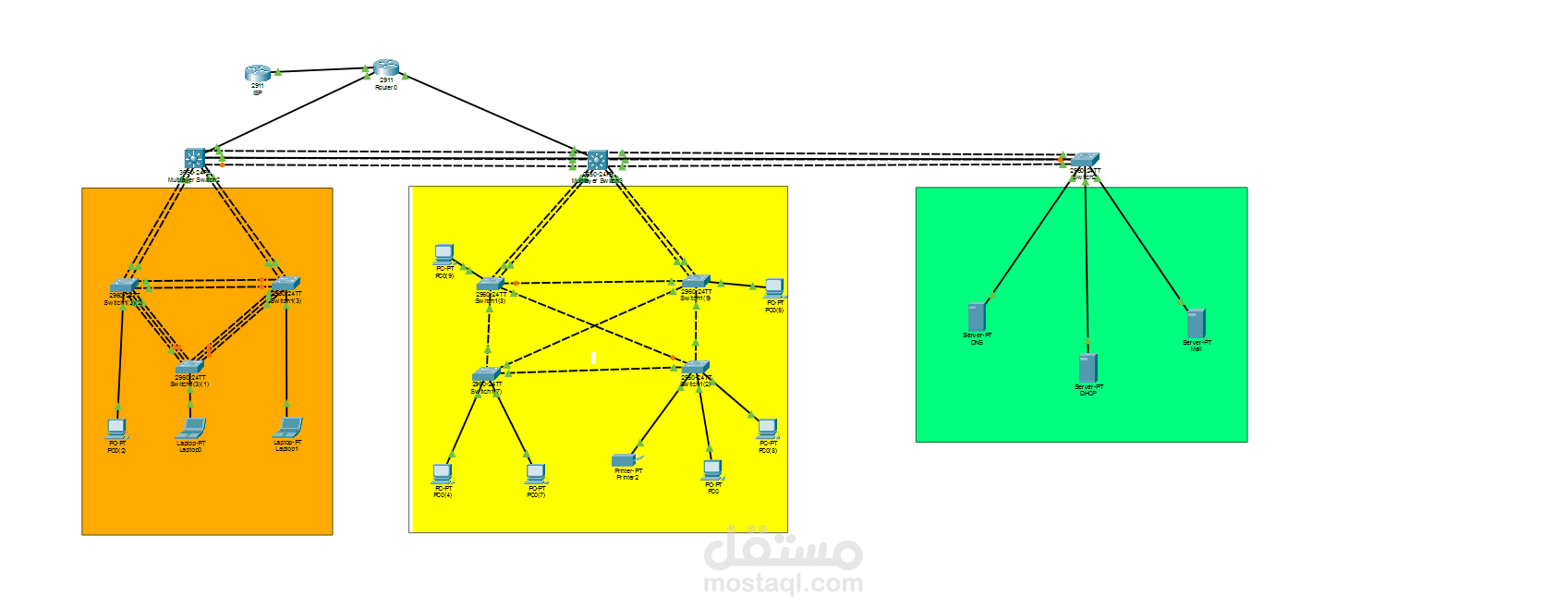
This project demonstrates a high-availability enterprise network design built using Cisco Packet Tracer. The network is structured with a hierarchical model consisting of Core, Distribution, and Access layers, ensuring scalability, redundancy, and efficient communication across all departments.
Key Features:
1. Hierarchical Network Design
The network follows the standard three-layer architecture:
Core Layer: Provides fast backbone connectivity between all network segments.
Distribution Layer: Uses multilayer switches for routing, VLAN management, and policy control.
Access Layer: Connects end-user devices such as PCs, laptops, printers, and servers.
2. Internet Connectivity
The network is connected to an ISP router, which provides external internet access through the main edge router.
3. Redundant Switching Topology
Multiple switches are interconnected with several backup links to avoid single points of failure. This improves availability and ensures continuous service if one link goes down.
4. Department Segmentation
The network is divided into different zones/departments:
User Access Area (Orange Zone): Contains PCs and laptops for staff users.
Office/Workgroup Area (Yellow Zone): Includes multiple switches, PCs, and printers.
Server Farm (Green Zone): Hosts centralized network services.
5. Server Infrastructure
Dedicated servers are deployed to provide important network services:
DNS Server – Resolves domain names to IP addresses.
DHCP Server – Automatically assigns IP addresses to devices.
Mail Server – Supports internal/external email communication.
6. End Devices
Connected devices include:
Desktop PCs
Laptops
Network printers
7. Routing and VLAN Support
Multilayer switches handle inter-VLAN routing, allowing secure communication between departments while maintaining traffic separation.
Project Objective:
To create a secure, scalable, and fault-tolerant enterprise network with centralized services, internet access, and strong redundancy to support business operations efficiently.