Agentic AI Customer Support Assistant
تفاصيل العمل
Project Overview
I designed and built an Agentic AI Customer Support Assistant for ITIL-aligned Managed Service Provider (MSP) environments, focused on transforming raw support tickets into structured, actionable insights for technicians.
The system acts as an AI-powered triage and decision-support layer on top of traditional Service Desk workflows, helping teams move from vague or incomplete tickets to clear problem understanding, validated priority, and guided resolution steps.
At its core, the platform combines LLM reasoning, workflow orchestration, and structured output enforcement to deliver reliable, auditable, and production-ready AI assistance in real-world IT operations.
The system operates in a controlled, advisory-only mode, ensuring safe integration into enterprise environments without disrupting existing workflows.
My Role
I led the end-to-end system design and implementation, including:
AI triage architecture and workflow orchestration (n8n-based)
Prompt engineering for deterministic, ITIL-aligned outputs
Backend workflow design and ticket processing pipelines
Structured AI output schema design (ai_intervention_v1)
Integration strategy with Service Desk systems
System safety, governance, and auditability design
This was built as a production-grade advisory system, not a prototype.
Architecture & Approach
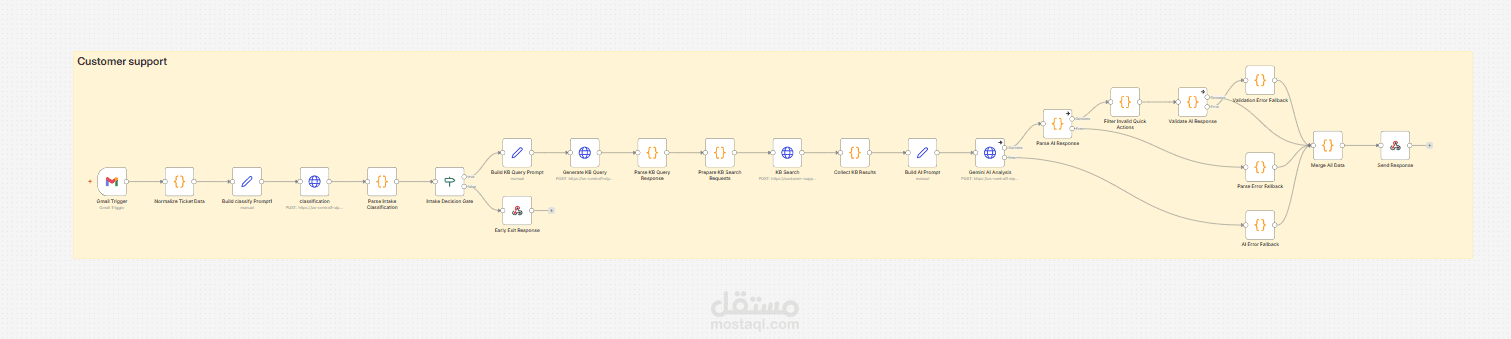
The system follows a pipeline-driven, backend-first architecture:
Ticket ingestion from Service Desk (API/Webhook)
Data normalization and enrichment
AI-powered ticket analysis and classification
Structured intervention generation (JSON-based)
Technician notification and review loop
Feedback logging for continuous improvement
A key design principle was strict separation between AI reasoning and system control, ensuring the AI never performs actions directly but instead assists human decision-making.
Tech Stack & Frameworks
Orchestration: n8n (self-hosted workflow engine)
AI Models: Google Vertex AI (Gemini)
Backend Services: Cloud Run (for scalable APIs & KB retrieval)
Database: PostgreSQL (with pgvector for semantic search)
Integration: ServiceDesk (ticket source)
Data Handling: Structured JSON schemas with strict validation
Key Engineering Contributions
1. AI-Powered Ticket Understanding & Normalization
Designed a preprocessing layer that transforms messy, real-world tickets into structured, high-quality inputs by:
Cleaning and normalizing ticket data
Standardizing priority formats (P1–P4)
Detecting categories (VPN, network, database, etc.)
Identifying VIP users and contextual signals
This ensures consistent and reliable AI reasoning regardless of input quality.
2. Structured AI Intervention System (ai_intervention_v1)
Developed a strict, production-grade AI output schema including:
Problem summary
Priority validation & correction
Business impact assessment
Missing information detection
Suggested solutions and workflow steps
Clarification questions for customers
Confidence scoring
All outputs are JSON-only, ensuring:
Deterministic behavior
Easy validation and debugging
Seamless system integration
3. ITIL-Aligned Priority Validation Engine
Built a controlled priority assessment system where AI:
Validates (not blindly overrides) user-defined priority
Uses impact + urgency models
Applies strict rules (e.g., P1 only for confirmed outages)
Avoids over-escalation and false urgency
This aligns AI decisions with real-world ITIL practices.
4. Runbook & Decision Support Generation
Designed a structured troubleshooting system that generates:
Quick actions (fast fixes with probability estimates)
Step-by-step runbooks (diagnostic → resolution)
Escalation conditions
Risk-aware actions (non-destructive first)
This turns AI from a “chat assistant” into a practical engineering tool.
5. Knowledge Base–Augmented Triage (Hybrid RAG)
Implemented a scalable retrieval system that enhances AI reasoning by:
Generating semantic search queries from tickets
Performing vector similarity search (pgvector)
Injecting relevant KB context only when confidence is high
Avoiding low-quality or irrelevant context injection
This significantly improves solution accuracy while maintaining reliability.
6. Safety, Governance & Human-in-the-Loop Design
Built strict guardrails to ensure enterprise safety:
AI cannot modify tickets
AI cannot escalate automatically
AI cannot contact customers without approval
All outputs require technician review
Full logging of AI suggestions and human corrections
This ensures trust, auditability, and controlled adoption in MSP environments.
7. Technician Feedback Loop & Learning System
Designed a feedback capture system where technicians:
Validate AI priority and solutions
Provide corrections
Add notes and improvements
These logs create a foundation for:
Continuous system improvement
Future learning pipelines
Advanced decision-support capabilities
Key Strengths of the System
AI integrated into real ITIL workflows (not standalone chatbot)
Strong separation of reasoning, control, and execution
Handles messy, real-world ticket data
Deterministic, structured, and auditable outputs
Human-in-the-loop validation for enterprise reliability
Scalable architecture (ready for autonomous phases)
Outcome
The platform enables support teams to:
Understand tickets faster and more accurately
Reduce back-and-forth with users
Improve priority classification consistency
Accelerate troubleshooting and resolution
Build a foundation for AI-driven support automation
It effectively acts as an AI-powered technician assistant, enhancing operational efficiency while maintaining full human control over decisions.