Presentation Title: Settlement
تفاصيل العمل
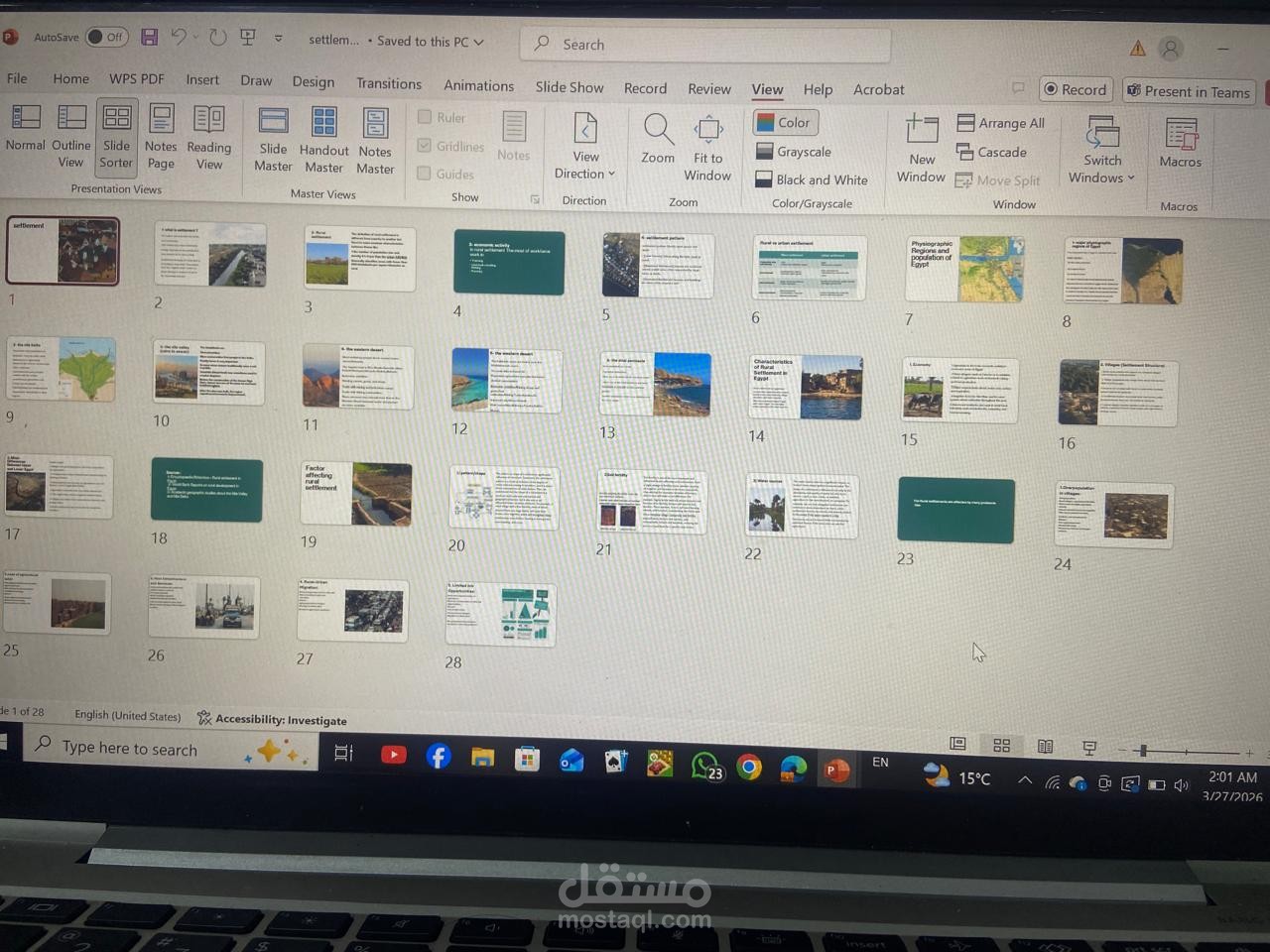
Presentation Title: Settlements and Population Density in Egypt
Slide 1: Title Slide
Title: Settlements and Population Density in Egypt
Subtitle: Patterns, Types, and Challenges
Your Name: Yousef Wael
Slide 2: Introduction
Egypt has diverse settlement patterns influenced by geography, economy, and culture.
Most people live along the Nile Valley and Delta.
Population density varies greatly between regions.
Slide 3: Types of Settlements in Egypt
Urban Settlements: Cities like Cairo, Alexandria – dense population, many services.
Rural Settlements: Villages – smaller population, agriculture-based.
New Communities: Planned towns and satellite cities.
Slide 4: Settlement Patterns
Linear: Along the Nile River and canals.
Dispersed: Small villages in desert oases.
Nucleated: Houses clustered around markets, mosques, or schools.
Slide 5: Factors Affecting Settlements
Physical factors: Water availability, fertile soil, climate.
Human factors: Job opportunities, transport, government policies.
Slide 6: Population Density in Egypt
High density: Nile Delta and Cairo – overcrowded areas.
Low density: Western Desert, Eastern Desert, Sinai – sparsely populated.
Reason: Most of Egypt’s land is desert, limiting habitable areas.
Slide 7: Challenges in Settlements
Overpopulation in cities leads to traffic and pollution.
Loss of agricultural land due to urban expansion.
Poor infrastructure in rural areas.
Rural–urban migration causes social and economic pressures.
Slide 8: Conclusion
Settlements and population density in Egypt are shaped by natural and human factors.
Planning is essential for sustainable development and improving living standards.