career expert system
تفاصيل العمل
Project Description
This project is a Career Expert System designed to provide intelligent and explainable guidance for individuals who want to start or switch their career in the tech industry.
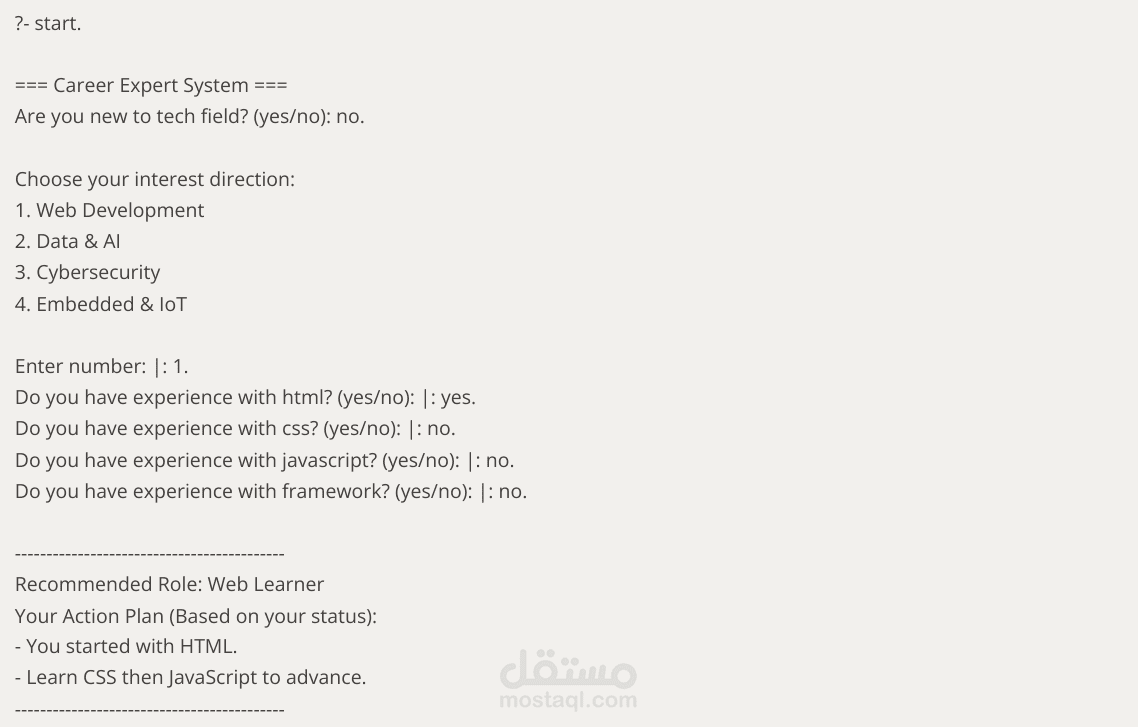
The system is implemented using Prolog and simulates human expert decision-making by analyzing user inputs such as experience level, interests, and technical skills. Based on this information, it generates personalized career recommendations along with a clear explanation and action plan.
Unlike traditional recommendation systems, this expert system focuses on logical reasoning and transparency, allowing users to understand why a specific career path is suggested.
Tools & Technologies
Prolog (Logic Programming Language)
Rule-Based Expert System Design
Knowledge Base & Inference Engine
Console-based User Interface
Core Concepts
Knowledge Base (facts + rules)
Inference Engine (decision-making logic)
Forward & Backward Chaining
Explainable AI (transparent reasoning)
How It Works
The system asks the user about their status:
New to tech
Career switcher
The user selects a preferred direction:
Web Development
Data & AI
Cybersecurity
IoT & Embedded Systems
The system evaluates the user’s skills based on the chosen direction.
Using rule-based logic, the system:
Matches user inputs with predefined rules
Generates a suitable career recommendation
Provides a detailed explanation and action plan
Usage
Run the Prolog program.
Start the system using the start predicate.
Answer the questions about:
Your experience level
Your area of interest
Your technical skills
The system will output:
Recommended career path
Personalized learning roadmap
Explanation of the decision
Features
Intelligent career recommendations
Explainable decision-making (transparent logic)
Context-aware (beginner vs. career switcher)
Direction-based skill assessment
Personalized action plans
Use Cases
Students choosing a tech career path
Professionals switching into tech
Educational tools for learning AI & expert systems
Academic projects (AI / Knowledge-Based Systems)
Limitations
Rule-based (does not learn automatically)
Limited to predefined knowledge
Binary skill evaluation (yes/no only)
Future Improvements
Add skill proficiency levels
Integrate Machine Learning
Expand career paths (DevOps, Mobile, etc.)
Add probabilistic reasoning
Improve user interaction