AI-Powered Document Generation System
تفاصيل العمل
Project Overview
This project focuses on building an AI-driven document engineering platform that transforms unstructured or semi-structured business inputs into fully structured, production-ready technical deliverables.
The system automates the generation of:
Software Requirements Documents
Technical Proposals
High-Level Designs (HLD)
Low-Level Designs (LLD)
The core objective is to accelerate solution architecture workflows by reducing manual effort and ensuring consistency, quality, and scalability in technical documentation.
The platform follows a modular pipeline approach where each stage builds on the previous one, ensuring alignment between requirements, architecture, and implementation layers .
My Role & Contributions
I was responsible for designing and implementing the core intelligence and automation layer of the system, focusing on both requirements engineering and architecture generation workflows.
1. Requirements Engineering & Framework Design
Designed a requirement classification framework to handle multiple input types (from vague ideas to enterprise-level specifications).
Built logic to transform raw input into structured:
Functional Requirements (FR)
Non-Functional Requirements (NFR)
Constraints, assumptions, and risks
Ensured the system can handle messy or contradictory inputs and convert them into production-ready requirement documents
2. HLD & Architecture Planning
Defined a standardized High-Level Design (HLD) generation approach, including:
System decomposition
Service boundaries
Data flow design
Deployment architecture
Ensured alignment between business requirements and technical architecture
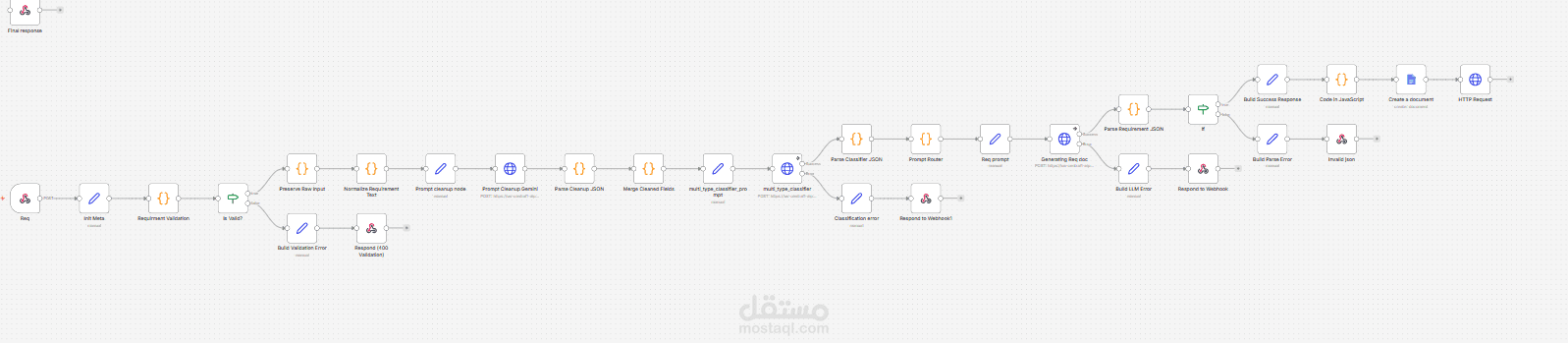
3. AI Orchestration & Automation (n8n)
Built a fully automated pipeline using n8n to orchestrate:
Input ingestion
LLM processing
Multi-stage document generation
Validation and approval flows
Designed modular workflows with:
Section-based generation
Merge and normalization stages
Feedback loops for iterative refinement
4. LLM Integration (Gemini)
Integrated Gemini (Vertex AI) as the core LLM engine
Designed structured prompts for:
Requirements generation
Architecture design
Technical proposal creation
Enforced strict JSON outputs for reliable downstream processing
5. Frontend & UX (Lovable + React)
Built the frontend using Lovable (React-based UI framework)
Focused on:
Clean user input experience
Structured output visualization
Interactive workflows for reviewing and refining documents
6. Cloud & Deployment
Designed a scalable architecture using:
Google Cloud Run for backend services
Cloud SQL for persistence
Ensured secure, scalable, and production-ready deployment
Tech Stack
Frontend: Lovable (React)
Backend: Node.js / TypeScript
Automation: n8n (workflow orchestration)
LLM: Gemini (Google Vertex AI)
Cloud: Google Cloud (Cloud Run, Cloud SQL)
Key Impact
Reduced manual effort in technical documentation by automating end-to-end document generation
Standardized requirements and architecture outputs across projects
Enabled rapid transformation from idea → architecture → implementation-ready design
Built a scalable foundation for AI-assisted solution engineering workflows