Student-Academic-Performance-Prediction
تفاصيل العمل
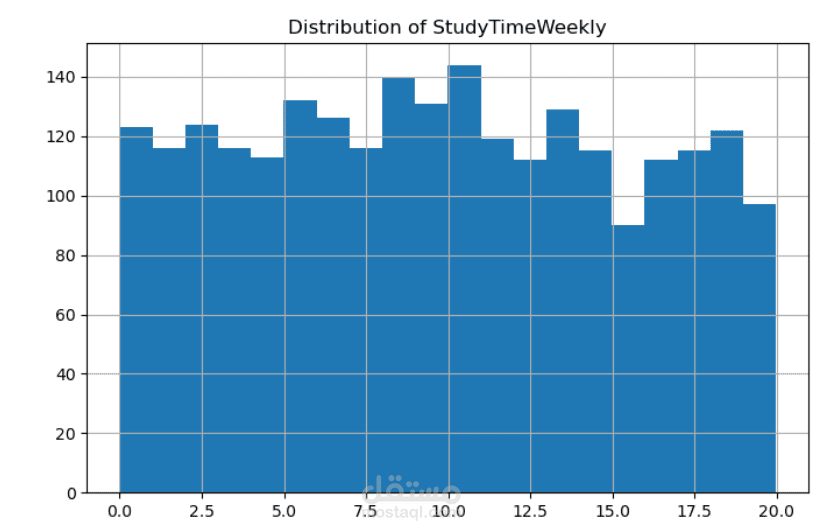
A Machine Learning project focused on predicting student academic performance using classification techniques. The project leverages student demographic, behavioural, and academic data to forecast outcomes such as grades or pass/fail status.
Key Features:
End-to-End ML Pipeline: Covers all stages of a typical machine learning workflow:
Data collection and cleaning
Exploratory Data Analysis (EDA)
Feature engineering and selection
Model training and hyperparameter tuning
Model evaluation and interpretation
Data-Driven Insights: Identifies which factors—such as study habits, attendance, parental background, and prior grades—most impact student performance.
Multiple Classification Models: Experiments with models like Logistic Regression, Random Forest, Gradient Boosting, and Support Vector Machines to find the most accurate predictor.
Robust Evaluation Metrics: Uses Accuracy, Precision, Recall, F1-score, and ROC-AUC to evaluate the model comprehensively.
Interpretability: Highlights important features to provide actionable insights for educators and administrators.
Implementation Steps:
Data Acquisition: Collect student datasets from schools, surveys, or publicly available sources.
Data Exploration: Analyse patterns, correlations, and trends in student attributes and outcomes.
Data Cleaning: Handle missing values, encode categorical variables, and normalize numerical data.
Feature Engineering: Create new features like average study hours, attendance ratio, or previous term performance.
Data Transformation: Convert categorical features into numeric representations using Label Encoding or One-Hot Encoding.
Train-Test Split: Split the dataset into training and testing sets to evaluate model performance.
Model Training: Train multiple classification models and tune hyperparameters for optimal accuracy.
Evaluation: Use multiple metrics to measure the performance and reliability of each model.
Prediction & Insights: Predict student outcomes and provide actionable insights for improving academic success.
Project Value:
Provides predictive insights into student performance, helping educators identify at-risk students early.
Demonstrates the application of machine learning for education analytics and data-driven decision-making.
Adds significant value to a Portfolio, showcasing skills in Data Preprocessing, Feature Engineering, Classification Modelling, and Model Interpretation.