ether channel
تفاصيل العمل
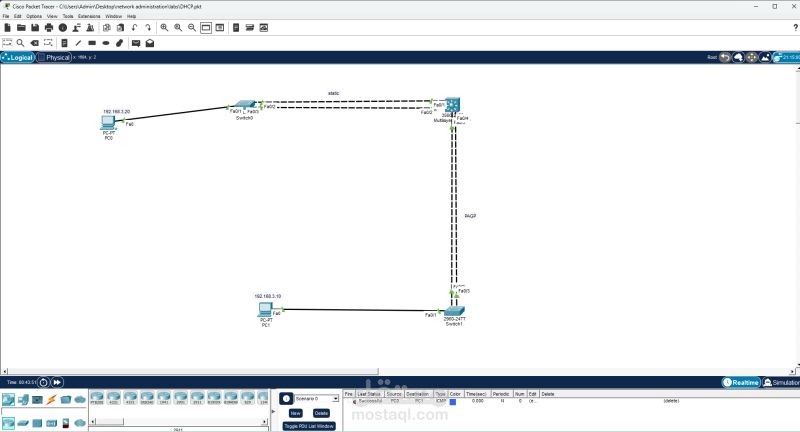
In this lab I worked on implementing EtherChannel using Cisco Packet Tracer to understand how multiple physical links between switches can be combined into a single logical connection to increase bandwidth and provide redundancy. The topology contains multiple switches including a multilayer switch and access switches connected to PCs, where several FastEthernet interfaces were bundled together to form an EtherChannel link.
First, I configured a static EtherChannel between switches, where the links are manually combined without a negotiation protocol. This helped me understand how the switch treats multiple interfaces as one logical port-channel and how this improves link utilization and prevents some of the limitations caused by spanning tree blocking individual links.
After that, I implemented PAgP (Port Aggregation Protocol) which is a Cisco proprietary protocol used to automatically negotiate EtherChannel formation. One side of the link was configured in auto mode while the other side was configured in desirable mode so that the switches could dynamically establish the aggregated link.
I also tested LACP (Link Aggregation Control Protocol) which is the IEEE standard for EtherChannel. In this case the ports were configured using active and passive modes to allow the switches to negotiate and create the port-channel automatically.
Finally, I verified connectivity between the PCs connected to different switches and confirmed that traffic successfully passed through the aggregated links. This lab helped me better understand how EtherChannel improves network performance, increases link availability, and provides load balancing across multiple physical interfaces in enterprise networks.
This lab helped me strengthen my understanding of Layer 2 technologies and switch-to-switch connectivity in enterprise networks.
Thank you ENG :Mohamed Salah Hegazy
hashtag#Networking hashtag#Cisco hashtag#CCNA hashtag#EtherChannel hashtag#LACP hashtag#PAgP hashtag#NetworkEngineering hashtag#PacketTracer