ipv6 config
تفاصيل العمل
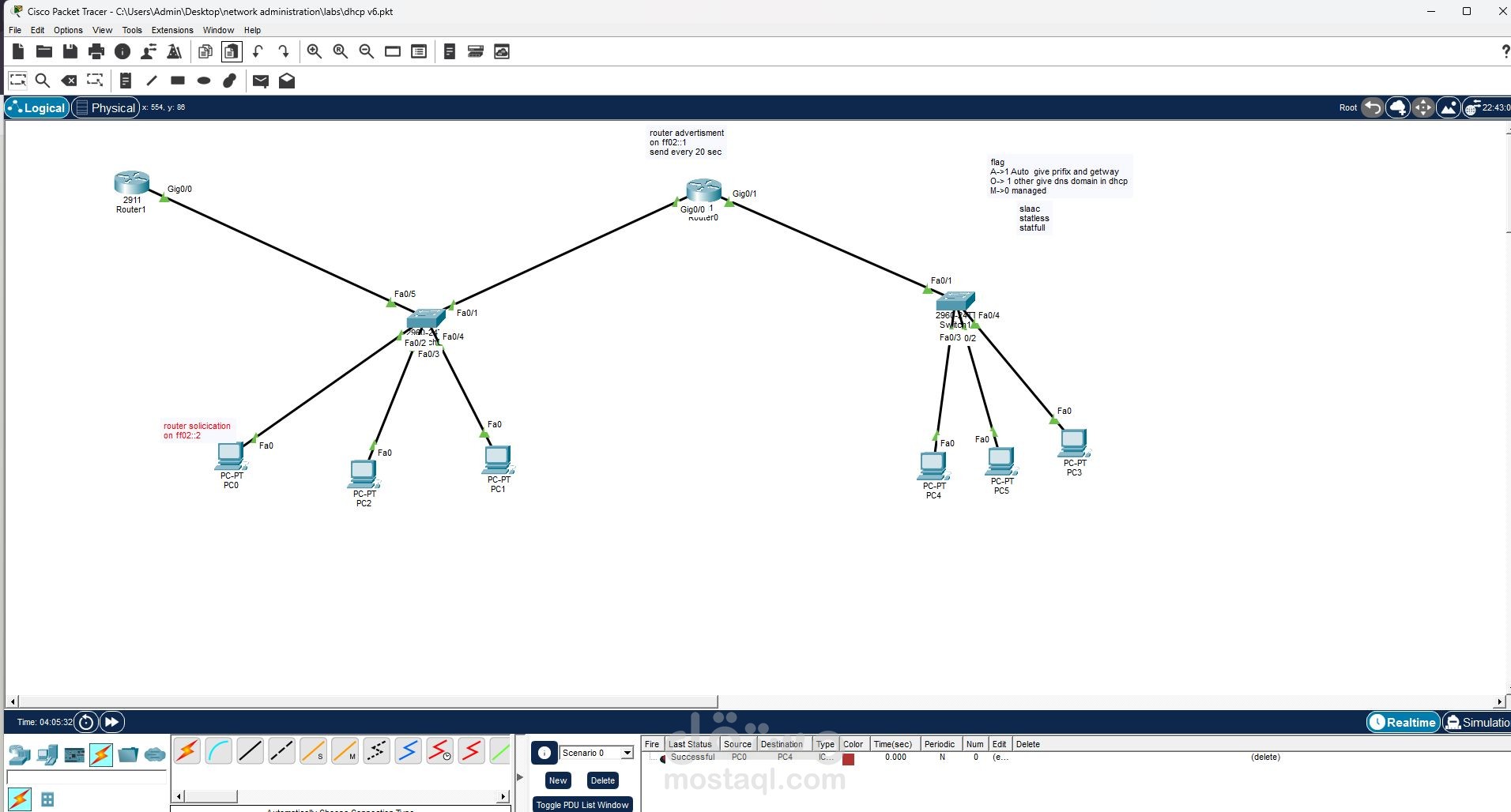
Continuing my networking practice, I recently completed a hands-on lab focused on IPv6 configuration and DHCPv6 using Cisco Packet Tracer.
In this lab, I built a small network topology consisting of routers, switches, and multiple PCs. The goal was to understand how IPv6 hosts obtain their network configuration using different mechanisms such as SLAAC (Stateless Address Autoconfiguration) and DHCPv6. I configured the router to send Router Advertisements (RA) so that hosts could automatically learn the network prefix and default gateway.
I also explored the different IPv6 flags used in Router Advertisements, including the A flag for autonomous address configuration, the O flag for additional information through DHCPv6, and the M flag for managed addressing. This helped me understand the difference between stateless DHCPv6 and stateful DHCPv6 and how each method is used in real network environments.
After completing the configuration, I verified that the hosts were able to receive IPv6 addresses automatically and tested connectivity across the network to ensure everything was functioning correctly.
This lab helped me strengthen my understanding of IPv6 addressing, Router Advertisements, SLAAC, and DHCPv6 configuration, which are essential skills for modern network design and implementation.
Thank you :Mohamed Salah Hegazy
hashtag#Networking hashtag#CCNA hashtag#Cisco hashtag#IPv6 hashtag#DHCPv6 hashtag#SLAAC hashtag#NetworkEngineering hashtag#PacketTracer