Presentation: "Active Noise Control: Modeling and Evaluation"
تفاصيل العمل
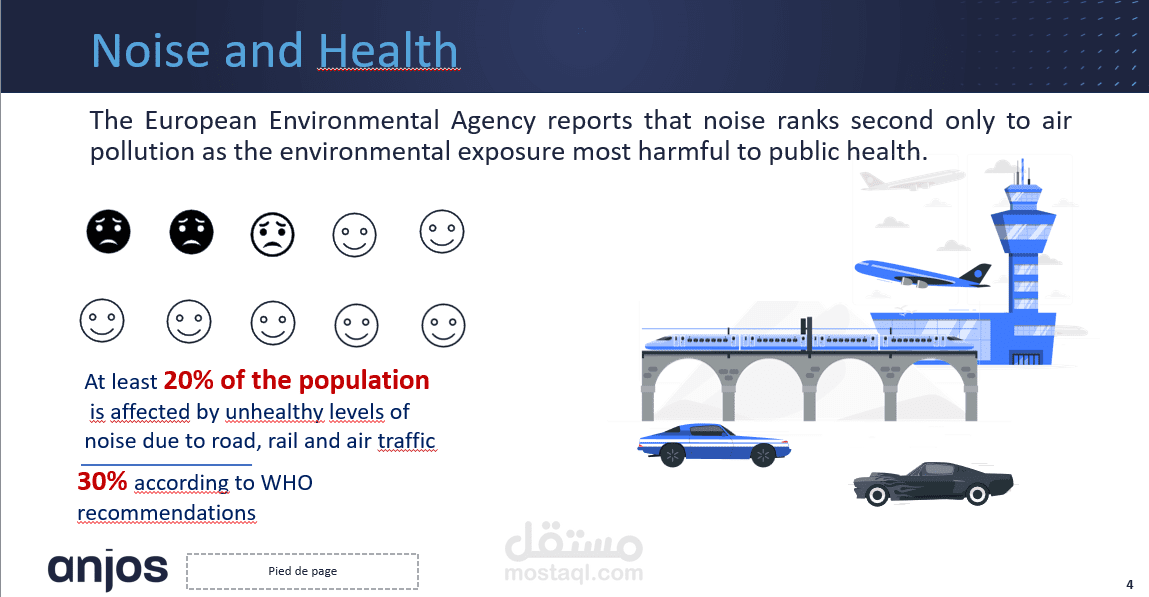
s part of my first-year PhD activities, I presented my research at the Journée des Doctorants at Anjos Ventilation, giving colleagues and fellow researchers an overview of my work on Active Noise Control (ANC) for ventilation systems. The presentation opened with a strong public health motivation, highlighting that noise pollution is the second most harmful environmental exposure in Europe, affecting over 20% of the population. I then introduced the limitations of traditional passive noise control solutions such as acoustic foam, which lose effectiveness at low frequencies — precisely where ANC becomes essential.
The core of the presentation covered the theoretical foundations of ANC, including the key algorithms (LMS and FxLMS) and the three main system architectures: feedforward, feedback, and hybrid. I then presented the results of my MATLAB/Simulink simulations, comparing the noise attenuation performance of different ANC models against both white and pink noise signals, alongside a benchmark against acoustic foam. The presentation concluded with perspectives for future work, focusing on experimental validation through a physical prototype and real-world secondary path estimation. This presentation demonstrated my ability to communicate complex signal processing and acoustics research to a multidisciplinary audience in a clear and structured manner.