predicting diabetes risk
تفاصيل العمل
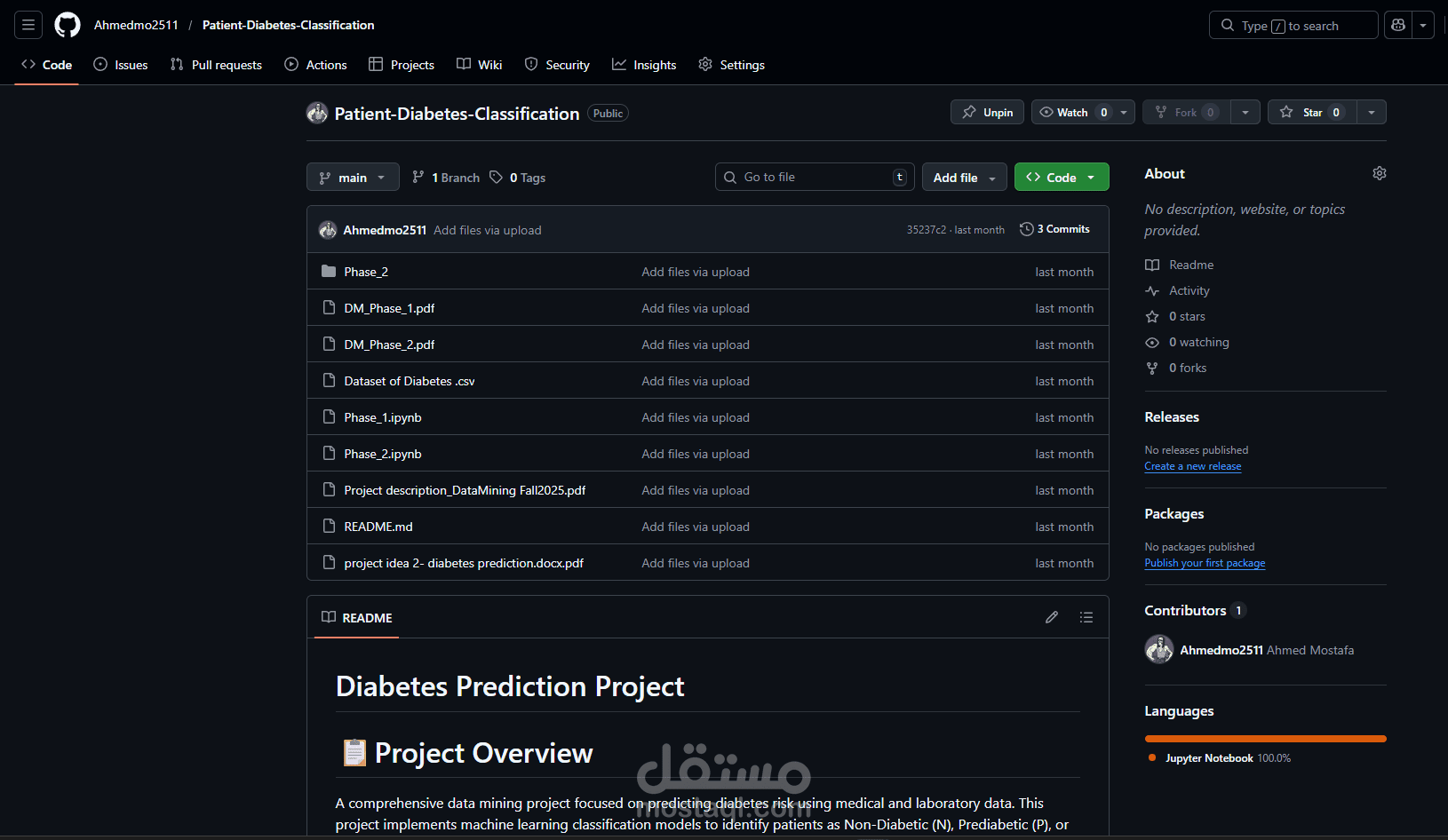
A comprehensive data mining project focused on predicting diabetes risk using medical and laboratory data. This project implements machine learning classification models to identify patients as Non-Diabetic (N), Prediabetic (P), or Diabetic (Y) based on clinical parameters.
? Project Objectives
Predictive Modeling: Develop accurate classification models for diabetes prediction
Risk Factor Analysis: Identify key clinical markers associated with diabetes
Data Insights: Explore patterns and relationships in medical data
Visual Analytics: Create comprehensive visualizations for data understanding
? Dataset Description
Features Overview Demographic: Gender, Age, BMI
Kidney Function: Urea, Creatinine (Cr)
Glucose Control: HbA1c (3-month average)
Lipid Profile: Total Cholesterol, Triglycerides, HDL, LDL, VLDL
Target: CLASS (N=Non-Diabetic, P=Prediabetic, Y=Diabetic)
Dataset Statistics Total Records: 1,000 patients
Features: 12 clinical parameters
Classes: 3 (N, P, Y)
Data Types: Numerical and categorical variables
?️ Technical Implementation
Phase 1: Data Preprocessing & Exploration ✅
Data Cleaning: Handle missing values, duplicates, and data validation
Outlier Detection: IQR method, Z-score, and medical range validation
Exploratory Analysis: Distribution analysis, correlation studies
Visualization: Comprehensive plots for data understanding
Phase 2: Feature Engineering & Modeling ?
Random Forest outperforms all other models.
• Using all features, it achieved the highest test accuracy (0.995), perfect precision (1.0), and very high recall (0.97) and F1-score (0.98). • Even with the strongest features only, Random Forest still performed excellently, showing its robustness.
SVM and Decision Tree models also perform well.
• SVM with all features achieved high precision (0.92) and recall (0.91), making it a strong choice for balanced performance. • Decision Tree improves slightly when using only the strongest features, achieving a test accuracy of 0.975.
Naive Bayes and KNN show moderate performance.
• Naive Bayes maintains consistent results with all features, but its performance drops with strong features. • KNN shows a slight improvement when using strong features, but its overall performance is lower than Random Forest and SVM.
Logistic Regression performs the worst among all models.
• Both with all features and strongest features, it has lower precision, recall, and F1-score, indicating it may not capture the complexity of the data as well as other models.
? Key Visualizations
Generated Plots: Outlier Detection Boxplots - Identify anomalies in clinical data
Distribution Analysis - Feature distributions with outlier highlighting
Correlation Heatmap - Relationships between clinical parameters
Pairplot Analysis - Multivariate relationships by diabetes class
Class-wise Distributions - Feature patterns across different classes