regression models
تفاصيل العمل
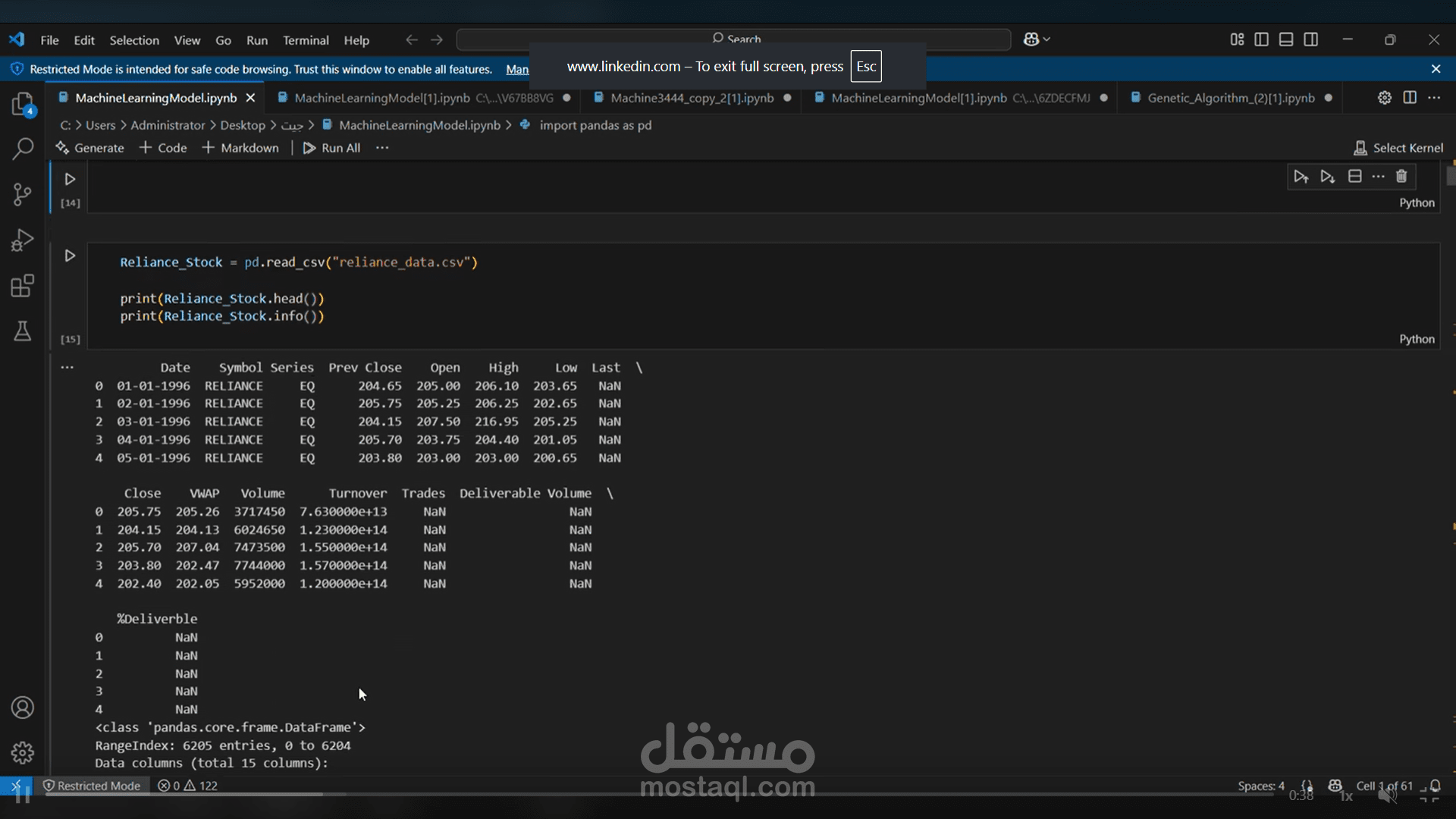
Over the past few weeks, I worked with an amazing team to build predictive models to forecast the closing price of Reliance stock using real financial data. Collaborating closely with my teammates helped us combine different skills and perspectives to deliver a stronger, more accurate project.
What we did together:
Explored and preprocessed real stock data (handling missing values, feature scaling, and selection)
Implemented and compared Simple Linear Regression, Multiple Linear Regression, and Polynomial Regression models with degrees 2 to 4
Evaluated models using R² score and Mean Squared Error to identify the best predictive approach
Visualized data relationships and model performance using correlation heatmaps and regression plots
What I learned:
The importance of data cleaning and feature engineering in predictive modeling
How polynomial regression can capture complex patterns better than simple linear models
Practical use of Python libraries such as pandas, scikit-learn, matplotlib, and seaborn for data science workflows
The value of thorough evaluation metrics and visualization for interpreting model results
How to collaborate effectively with a team and leverage collective strengths
Why it matters:
Stock price prediction remains a challenging yet vital task for investors and analysts. Through this project, I gained deeper insight into machine learning techniques and improved my skills in handling real-world datasets — a critical step towards building robust financial models.