Running a DC Motor Using an AC Source with Step-Down Transformer and Rectifier
تفاصيل العمل
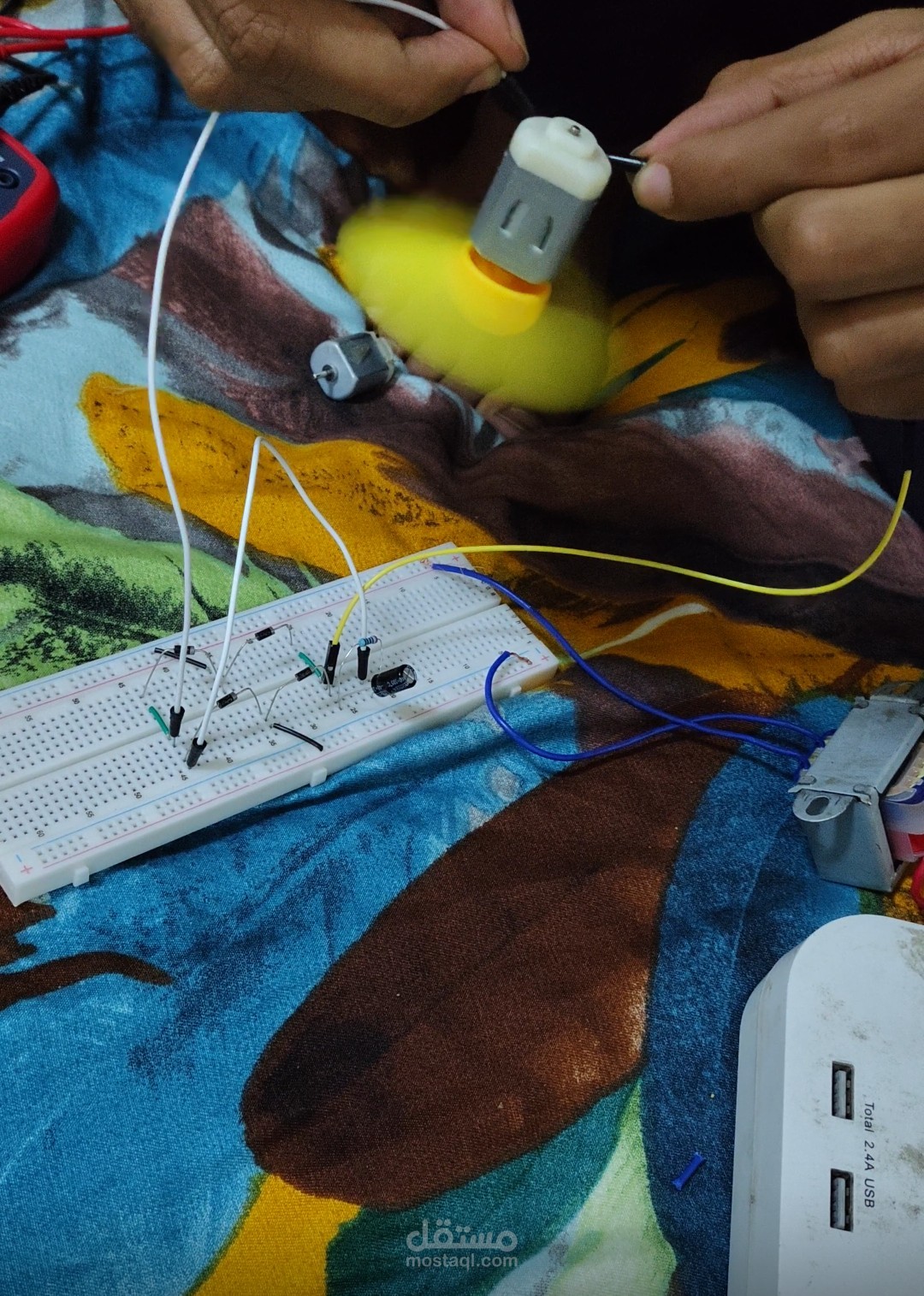
This project demonstrates how a DC motor can be operated using an AC power supply by converting alternating current (AC) into direct current (DC). Since DC motors require DC voltage and most power sources provide AC, a conversion system is needed. The system uses a step-down transformer and a rectifier circuit to supply suitable DC voltage to the motor.
The project shows the practical implementation of AC–DC power conversion and basic motor control principles.
Objective
To convert AC supply into DC supply.
To reduce voltage to a safe operating level for a DC motor.
To run and test a DC motor using rectified power.
To understand rectification and power supply circuits.
Main Components
1. AC Supply
Input power source (typically 220V or 110V AC).
Provides alternating voltage.
2. Step-Down Transformer
Reduces high AC voltage to lower AC voltage (e.g., 220V → 12V).
Protects the motor from high voltage damage.
3. Rectifier Circuit
Converts AC to DC.
Usually uses diodes (half-wave or full-wave/bridge rectifier).
4. Filter (optional but common)
Capacitor used to smooth pulsating DC.
Reduces ripple and provides steady voltage.
5. DC Motor
Converts electrical energy into mechanical rotation.
Working Principle
AC input is supplied to the step-down transformer.
The transformer reduces the voltage to a lower AC level.
The rectifier circuit converts AC into pulsating DC.
The filter capacitor (if used) smooths the DC output.
The DC voltage powers the motor, causing it to rotate.
Block Diagram (Conceptual Flow)
AC Supply → Step-Down Transformer → Rectifier → Filter → DC Motor
Applications
Power supply design
Battery charging circuits
Industrial motor drives
Electronics power systems
Educational demonstration of AC–DC conversion
Advantages
Uses standard AC power to run DC devices.
Simple and low-cost circuit.
Demonstrates power electronics concepts.