OSPF (ROUTING)
تفاصيل العمل
Project Description:
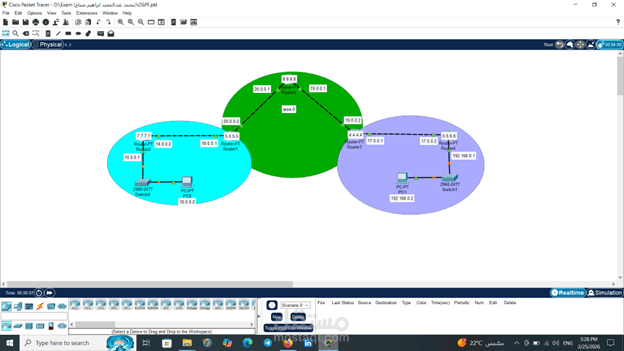
A sophisticated network topology designed in Cisco Packet Tracer demonstrating the implementation of OSPF (Open Shortest Path First) routing. The project showcases a scalable hierarchical network structure, focusing on efficient route propagation and inter-area connectivity.
Key Technical Features:
Multi-Area OSPF Design: Configured a central Backbone Area (Area 0) to interconnect different network segments, ensuring optimal path selection and reduced routing overhead.
Dynamic Route Propagation: Enabled OSPF on multiple routers to automatically discover neighbors and maintain a synchronized link-state database (LSDB).
Router ID & Loopback Configuration: Assigned unique Router IDs (e.g., 8.8.8.8, 5.5.5.5, 4.4.4.4) for stable OSPF process identification and management.
Area Border Routing (ABR): Set up routers to act as boundaries between the backbone and non-backbone areas, managing the summarization of routing information.
Scalable Topology: The design includes distinct zones (Cyan, Green, and Purple) representing different departments or geographical locations connected through a high-speed core.
Redundancy and Convergence: Configured to ensure fast network convergence in case of link failures, maintaining high availability for end-user devices.