Online_Retail
تفاصيل العمل
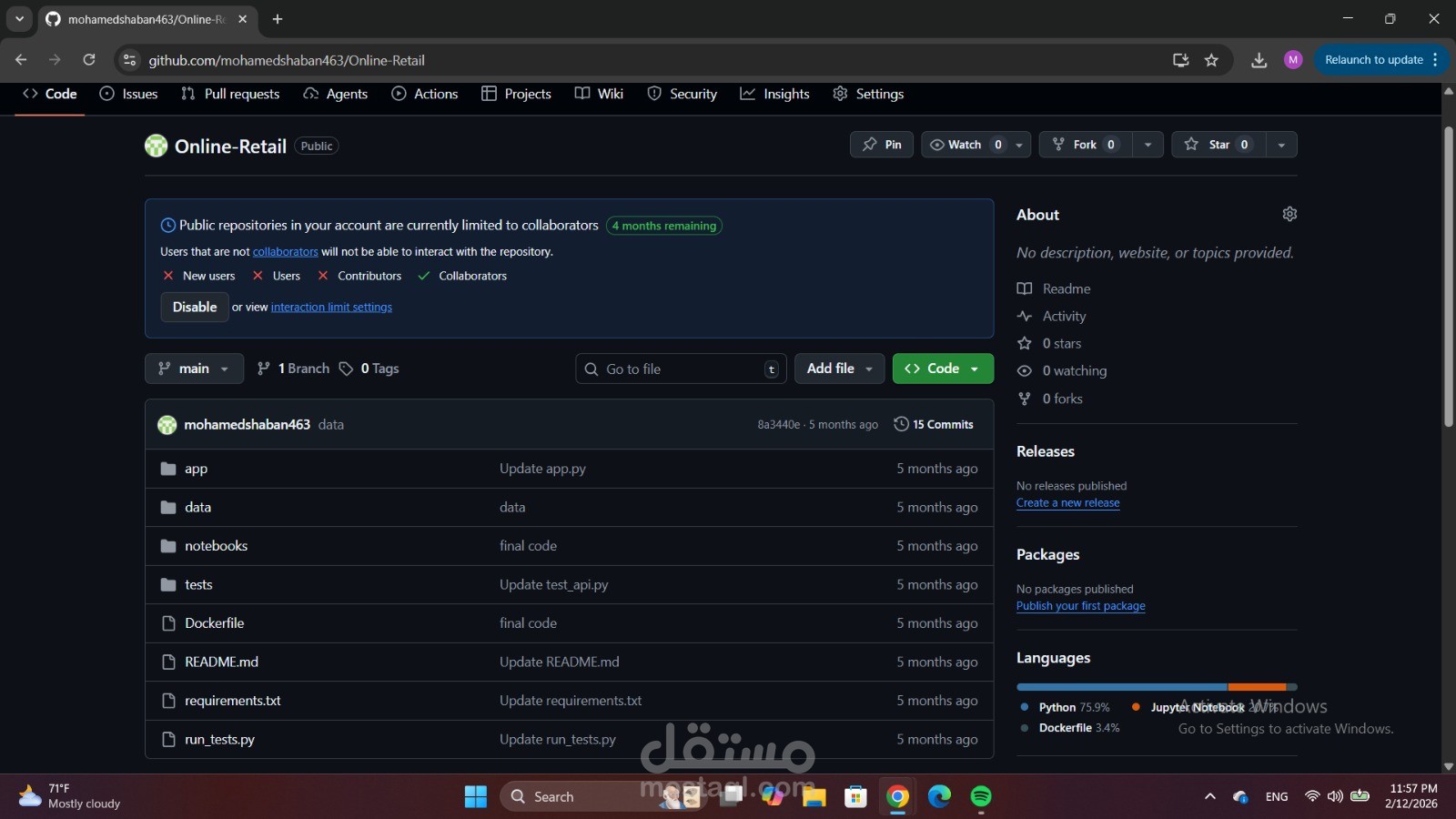
Project Overview: Online Retail Analytics Pipeline
This repository contains an end-to-end Data Engineering and Machine Learning Pipeline designed to analyze e-commerce transaction workflows. Utilizing the classic Online Retail II transactional dataset, the application ingests raw data, processes it via dedicated pipeline scripts, extracts behavioral or predictive metrics (such as customer segmentation, recommendation logic, or sales trends), and exposes these insights through a web app interface or API endpoint.
Key Architectural Components
The repository is organized logically to separate data processing, core application logic, and system deployment:
data_ingestion.py: Handles the extract, transform, load (ETL) processing layer—reading, cleaning, and formatting raw transactional data from the spreadsheet.
model_utils.py: Stores the machine learning and analytical utility functions (e.g., executing RFM customer clustering, predictive scoring, or statistical arrays).
app.py: Serves as the main execution block and front-facing web interface or API gateway that visualizes data insights or serves model predictions.
logger.py: A unified module managing structured application logging across the entire ingestion and serving lifecycle.
data/online_retail_II.xlsx: The core data asset, containing real-world retail logging histories used to train and feed the analytical models.
Dockerfile: Defines the deployment ecosystem, packaging dependencies into a single blueprint for zero-overhead distribution.
Languages, Frameworks & Tools
Given the module architecture, the tech stack consists of the following standard data-science and web deployment tools:
Core Language: Python (Powering all backend logic, mathematical utility functions, and deployment scripts)
Containerization & DevOps: Docker (Used to build an isolated, reproducible runtime environment from the Dockerfile)
Web Framework Layer: Highly likely built with Streamlit, FastAPI, or Flask (inferred from the standard pythonic implementation for an analytical app.py entrypoint)
Data Processing Stack: Pandas and OpenPyXL (essential for ingesting and manipulating data structured within .xlsx formats)
Machine Learning Suite: Scikit-learn or NumPy (powering the algorithmic matrices tucked inside model_utils.py)