The Keeper of Lost Seconds
تفاصيل العمل
2. Thematic Framework
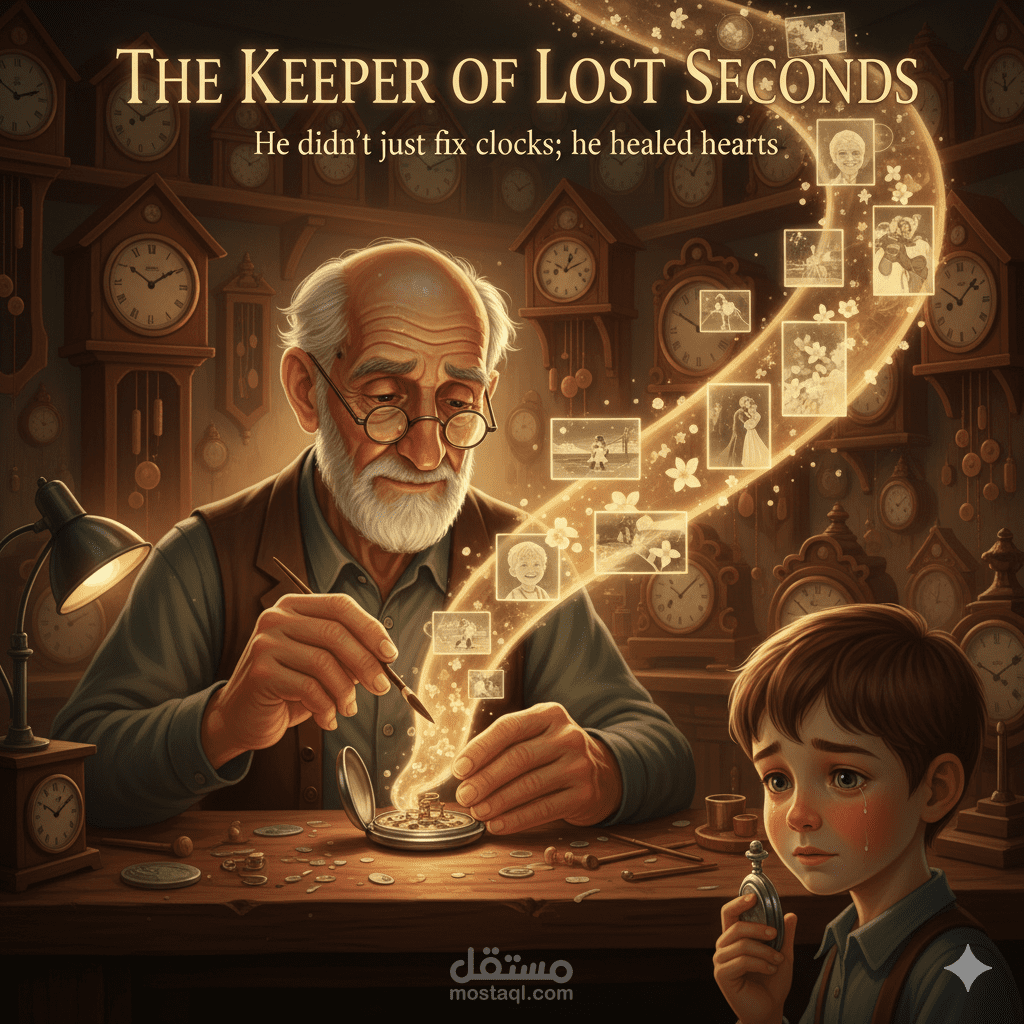
Temporal Sentience: The narrative posits that timepieces are sentient witnesses to human life. A stopped clock is treated not as a mechanical failure, but as a "frozen trauma" or a preserved memory awaiting liberation.
Intergenerational Legacy: The transition of the shop from Elias to Leo symbolizes the continuity of wisdom and the importance of preserving intangible heritage.
Redemption and Reconciliation: Elias’s internal journey—from a man lost in the "clocks of strangers" to someone who reclaims his own time through a letter of reconciliation—highlights the theme of self-forgiveness.
3. Symbolic Inventory
The Silver Pocket Watch: A metaphor for the living soul. Its rhythmic tick serves as an auditory bridge between the living (Leo) and the departed (his grandfather).
The Sand and the Petal: These micro-details represent the "physicality of memory." They prove that our past leaves tangible traces in the machinery of our daily lives.
The Synchronized Chime: The climax, where all clocks beat in unison, signifies Universal Harmony. It represents the moment Elias aligns his internal spirit with the external world.
4. Narrative Tone and Aesthetic
The prose is atmospheric and evocative, utilizing sensory imagery—the scent of aged cedar, the tactile cold of brass, and the rhythmic "heartbeat" of the workshop—to create an immersive experience. The tone balances melancholy (the loss of the grandfather) with luminous hope (the ticking watch and the rising sun).
5. The Core Message (The "Takeaway")
The story concludes with a powerful philosophical thesis: "We are all just keepers of seconds." It challenges the reader to shift their perspective from "spending" time to "cherishing" it, asserting that the value of life is found in the emotional quality of our moments rather than their quantity.