Intelligent Cooling System for Engines Using Phase Change Materials (PCM)
تفاصيل العمل
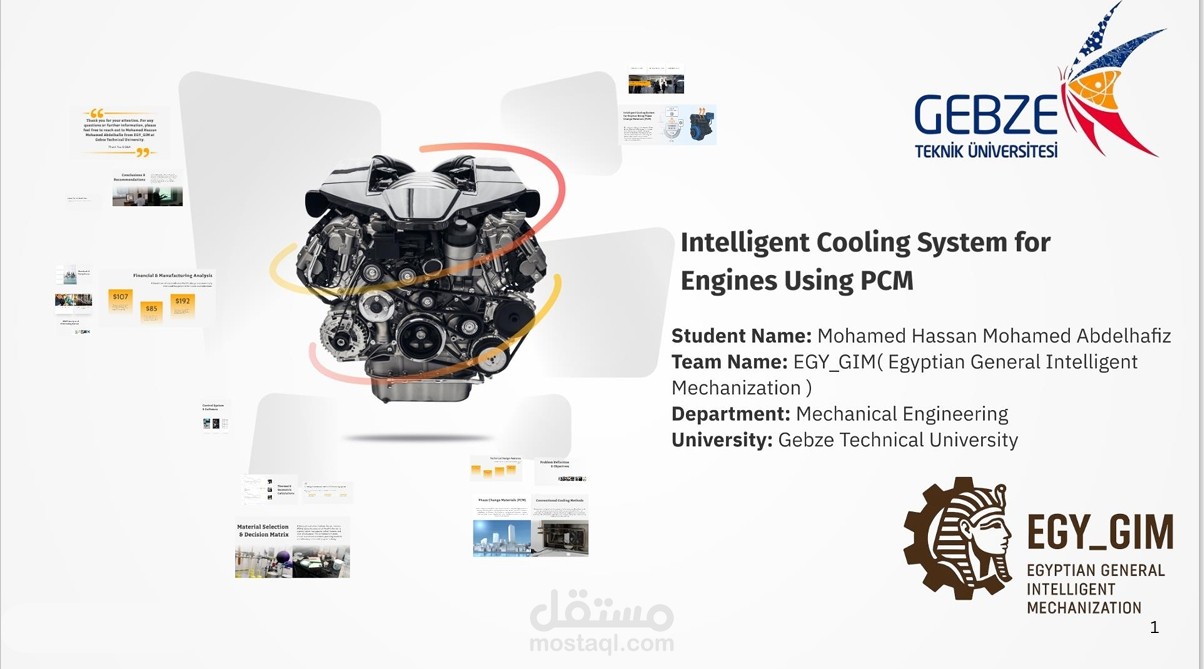
Engines operating under high-load or extreme environmental conditions often face significant
thermal challenges. Excessive heat not only reduces engine efficiency but can also lead to
premature wear, component failure, and increased energy consumption due to the need for active
cooling systems such as fans or pumps.
Phase Change Materials (PCMs) have recently gained attention in the thermal management field
due to their ability to absorb and release large amounts of latent heat while maintaining a nearly
constant temperature during phase transition. When strategically integrated into engine systems,
PCMs offer a passive and reliable method to stabilize temperatures, especially during short-term
thermal spikes.
This project aims to design and develop an intelligent engine cooling system that leverages the
thermal storage capabilities of PCM and incorporates a smart control unit to monitor and
optimize cooling behavior. Unlike conventional systems that depend solely on air or liquid
cooling, this system introduces an adaptive approach that responds dynamically to engine heat
loads.
The proposed system is particularly relevant for applications such as electric vehicles, aviation
engines, and industrial machinery—fields where compact, efficient, and maintenance-free
cooling solutions are increasingly demanded.
By exploring material selection, geometric integration, control algorithms, and financial
feasibility, this project presents a comprehensive approach to enhancing engine reliability and
efficiency in a sustainable manner.