Sleep Apnea Detection using ECG Signal (Graduation project)
تفاصيل العمل
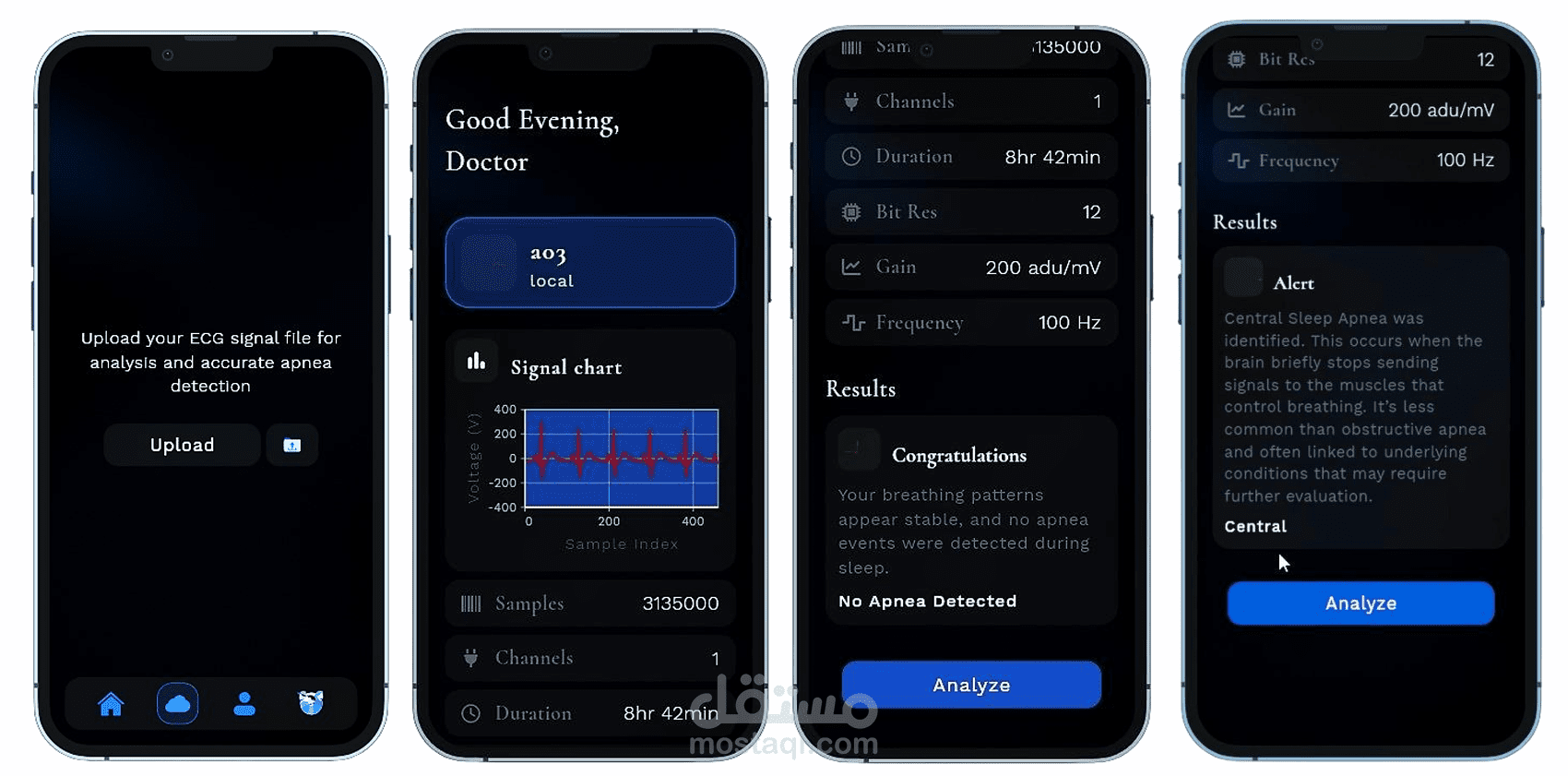
This project focuses on developing an artificial intelligence–based system for detecting sleep apnea using single-lead ECG signals. Sleep apnea is a serious and often underdiagnosed condition, especially in regions where access to specialized sleep laboratories is limited. Traditional diagnostic methods such as polysomnography are accurate but expensive, invasive, and not practical for large-scale or home-based screening. This work proposes an alternative approach that relies on ECG signals, which are simple, affordable, and non-invasive, making them suitable for both clinical use and everyday monitoring.
The system is designed to automatically analyze ECG recordings and identify apnea events with high accuracy. One of its main strengths is its ability to perform both binary classification, distinguishing between normal and apnea cases, and multi-class classification, identifying different types of apnea such as obstructive, central, and hypopnea. By leveraging deep learning models, the system captures subtle changes in heart rate and signal patterns that occur during apnea events. This allows for early detection and reliable screening, even outside traditional medical settings.
The implementation begins with collecting ECG data from well-known medical databases that contain expert-labeled apnea events. The signals are then carefully preprocessed to enhance their quality by removing noise and correcting baseline drift. Each ECG recording is segmented into one-minute intervals to ensure consistency and improve model performance. Meaningful features related to heart rate variability, signal entropy, and time-frequency characteristics are extracted to represent the physiological changes associated with sleep apnea.
Advanced machine learning and deep learning models are then trained on these features. Residual neural networks are used for binary classification, while transformer-based and hybrid architectures combining gradient boosting and recurrent neural networks are employed for multi-class classification. These models demonstrate strong performance and generalization across different datasets. To ensure practical usability, the trained models are integrated into a user-friendly application connected to a backend server through a Flask API. Users can upload ECG files and receive clear diagnostic results, making the system accessible to both healthcare professionals and individuals at home.
Overall, this work presents a scalable, affordable, and non-invasive solution for sleep apnea detection. By combining signal processing, deep learning, and real-world deployment, the project offers a promising tool for improving early diagnosis, enhancing sleep healthcare, and increasing access to medical screening in underserved regions.