Facility Layout Optimization Using Graph Theory
تفاصيل العمل
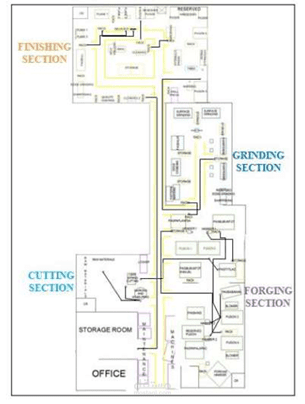
This project focused on optimizing the facility layout for the Philippine Metal Production Company, a manufacturer of specialized blades used in agriculture, horticulture, and woodworking.
The Challenge:
Design a layout that minimizes material movement, reduces cycle time, and maximizes productivity while balancing cost, flexibility, and maintenance considerations.
Approach:
We applied graph theory to model departmental workflows and relationships, transforming operational data into structured networks. Using multi-criteria decision-making (AHP), we evaluated layout alternatives against key business priorities:
✅ Productivity
✅ Initial Investment
✅ Flexibility
✅ Ease of Maintenance
Key Activities:
Mapped inter-departmental interactions using adjacency matrices and relationship diagrams.
Developed and visualized multiple layout alternatives.
Conducted weighted scoring and consistency validation to ensure reliable outcomes.
The Outcome:
We found an alternative that emerged as the optimal layout, achieving the highest overall score (0.3662). It excelled in flexibility—supporting future scalability—while maintaining strong performance across all other criteria. The result is a leaner, more efficient facility designed for productivity and growth.
This project highlights how data-driven design and operations research can transform traditional facility planning into a strategic, impact-driven process.