Vector Indexing Project
تفاصيل العمل
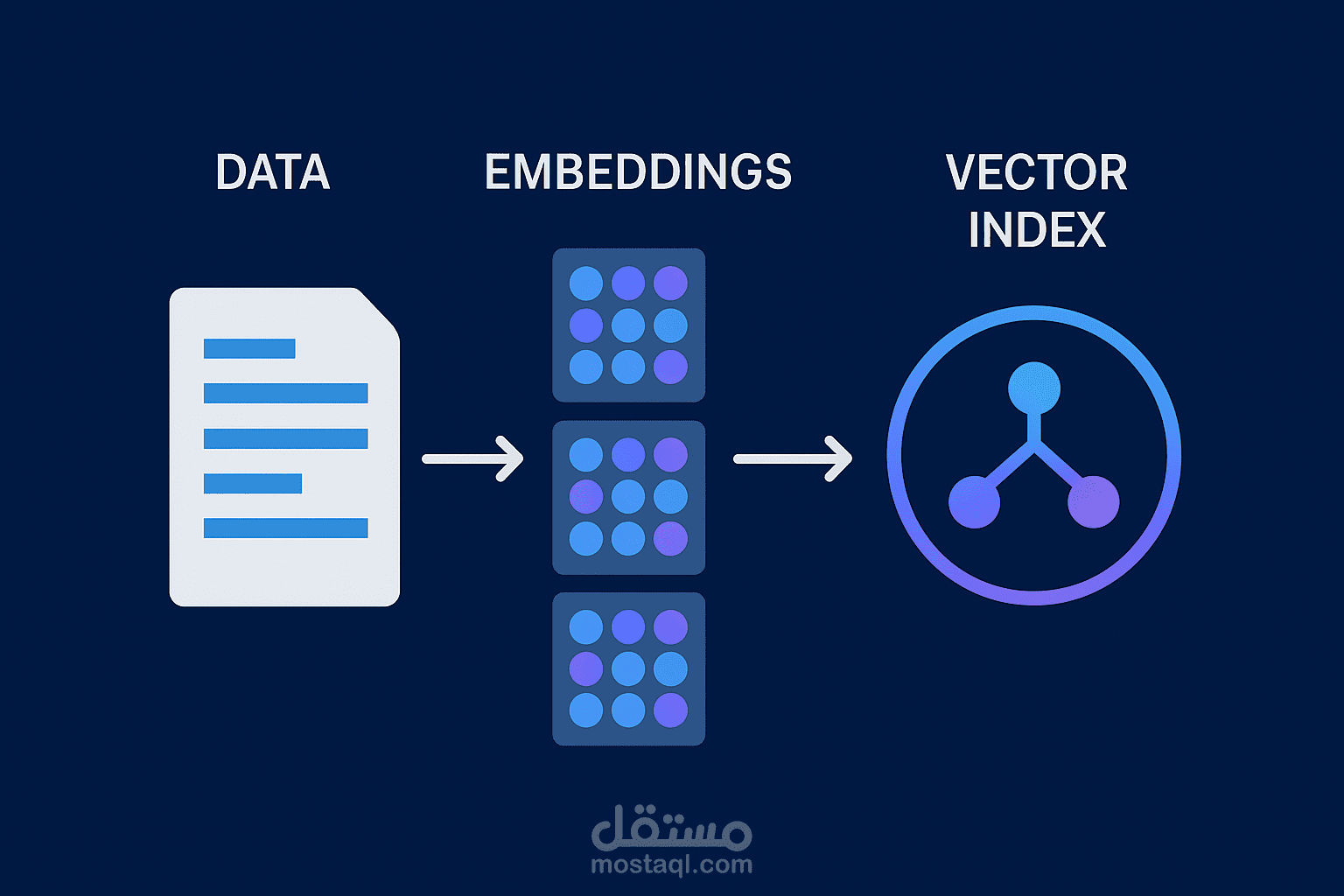
Vector-Indexing
What is Vector-Indexing
Vector-Indexing is a lightweight, easy-to-use Python library for building vector indexes over arbitrary data embeddings — enabling fast similarity search and semantic retrieval. Rather than relying on classic keyword-based or relational search, Vector-Indexing lets you index high-dimensional vector embeddings (e.g. from text, images, or other data) and query them efficiently, enabling modern AI/ML use cases such as semantic search, recommendation, clustering, deduplication, and more.
With Vector-Indexing, you get a simple, standalone, Python-native solution — no heavy database setup, no external infrastructure required. Whether you're prototyping or building a production system, Vector-Indexing makes vector search accessible and manageable.
Why Vector Indexing Matters
Semantic Search & Similarity Retrieval: Vectors (embeddings) capture meaning and semantic relationships beyond mere keyword matching. A vector index allows you to search based on semantic similarity, not just exact string matches.
AI21
+2
Fast Data Science
+2
Performance & Scalability: High-dimensional data (embeddings) cannot be searched efficiently with traditional indexes (like B-trees). Vector indexes (especially approximate nearest neighbor — ANN — structures) are optimized for speed and scale.
Teradata
+2
NVIDIA
+2
Flexibility for Unstructured Data: Works with any data type that can be embedded — text, images, audio — making it ideal for modern unstructured data scenarios (documents, multimedia, user interactions, etc.)
imdeepmind.com
+2
IBM
+2
Simple Integration: Because Vector-Indexing is a Python library, integrating into existing pipelines or applications is straightforward, without heavy dependencies or infrastructure overhead.
Key Features
Build vector indexes from arbitrary embeddings (vectors)
Support for similarity search (nearest-neighbor / nearest-vector queries)
Easy to integrate into existing Python codebases
Lightweight and self-contained — no external database or service required
Flexible: works with any embedding source (text embeddings, image embeddings, custom numerical data)
Exposes simple API to add, query, update, and persist vector data