Legal contract
تفاصيل العمل
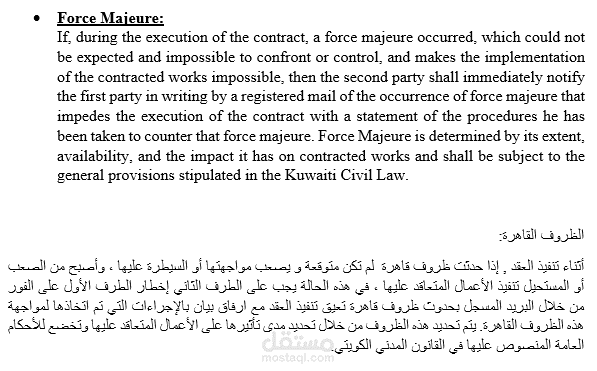
The text is a legal contract clause discussing Force Majeure, translated from English to Arabic.
Here’s an analysis of the type of translation, its features, and the appropriate translation method:
First: Type of Translation
This is a specialized legal translation.
The text belongs to an official contract between two parties and contains legal clauses that regulate rights and obligations in the event of force majeure.
Second: Features of Legal Translation
Accuracy and clarity: The legal meaning must be conveyed precisely, with no additions or omissions.
Use of correct legal terminology: e.g., Force Majeure = الظروف القاهرة.
Formal style: The language must be formal, avoiding emotional or subjective expressions.
Terminological consistency: The same terms must be used consistently throughout (e.g., “the first party,” “the second party”).
Textual correspondence: Each clause in the translation should correspond clearly to its source counterpart.
Legal system alignment: Since the clause refers to the Kuwaiti Civil Law, terminology must be aligned with the Kuwaiti legal system rather than using general legal terms.
Third: Appropriate Translation Method
Analytical reading first: Understand the source text from a legal perspective before translating.
Controlled literal translation:
Not a word-for-word rendering, but one that preserves the legal structure and meaning.
Example:
“the second party shall immediately notify the first party in writing by a registered mail”
should be translated as:
“يجب على الطرف الثاني أن يُخطر الطرف الأول كتابيًا بموجب رسالة مسجلة.”
Verification of legal terminology:
Use specialized legal dictionaries (e.g., Black’s Law Dictionary or bilingual legal dictionaries).
Post-translation review:
Check for consistency, correct legal references, and maintain a formal tone.