Integrative Bioinformatics Analysis of MicroRNA and Gene Interactions For Revealing Potential Biomarkers of Non-Small Cell Lung Cancer
تفاصيل العمل
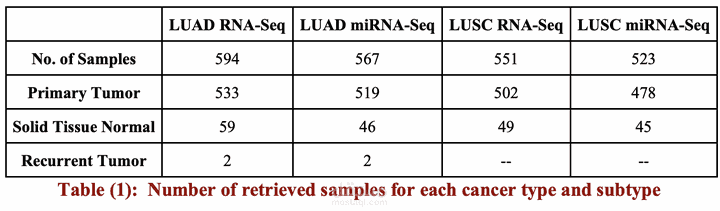
This research study, titled “Integrative Bioinformatics Analysis of MicroRNA and Gene Interactions for Revealing Potential Biomarkers of Non-Small Cell Lung Cancer,” aims to identify novel diagnostic and prognostic biomarkers for the two major subtypes of non-small cell lung cancer (NSCLC): lung adenocarcinoma (LUAD) and lung squamous cell carcinoma (LUSC). The project leverages high-throughput sequencing data from The Cancer Genome Atlas (TCGA) and employs differential expression analysis using the DESeq2 package to pinpoint significantly altered mRNAs and microRNAs between tumor and normal tissue samples. Data visualization techniques, including volcano plots, MA plots, and heatmaps, are utilized to illustrate these differences, while functional enrichment analysis via FUNRICH reveals the involvement of key genes in essential biological processes such as cell growth and maintenance. Furthermore, the study constructs gene–miRNA interaction networks using Cytoscape and GeneMANIA to uncover common molecular players between LUAD and LUSC. Kaplan-Meier survival analyses link specific biomarkers, such as ANXA10 and CLEC3B, to patient outcomes, and differential DNA methylation analysis highlights significant epigenetic alterations in each subtype. Together, these integrative bioinformatics approaches provide deeper insight into the distinct molecular mechanisms underlying NSCLC and offer promising avenues for early diagnosis and improved therapeutic strategies.