Automobile Fuel Efficiency Prediction Using Linear and Regularized Regression Models
تفاصيل العمل
Type of Work
This project is a classic example of supervised machine learning, specifically a regression analysis. The primary goal is to build a predictive model that can estimate a continuous numerical value—in this case, the fuel efficiency of an automobile measured in Miles Per Gallon (MPG). By analyzing a historical dataset of various cars and their attributes, the project demonstrates how to create a model that can learn the complex relationships between a car's specifications and its fuel consumption. This type of predictive modeling is fundamental to data science and has practical applications in automotive design, consumer reporting, and environmental impact analysis.
Key Features and Implementation
The implementation of this project follows a standard and crucial machine learning pipeline, which can be broken down into several key phases. It begins with data acquisition and exploration, where the dataset is loaded from a public repository and its structure, contents, and data quality are initially assessed using methods like info(), head(), and checking for missing values. The subsequent data preprocessing phase is critical for model performance; here, six records with missing 'Horsepower' values are removed, and a MinMaxScaler is applied to normalize all feature values to a consistent range between 0 and 1, ensuring that no single variable dominates the model simply due to its scale.
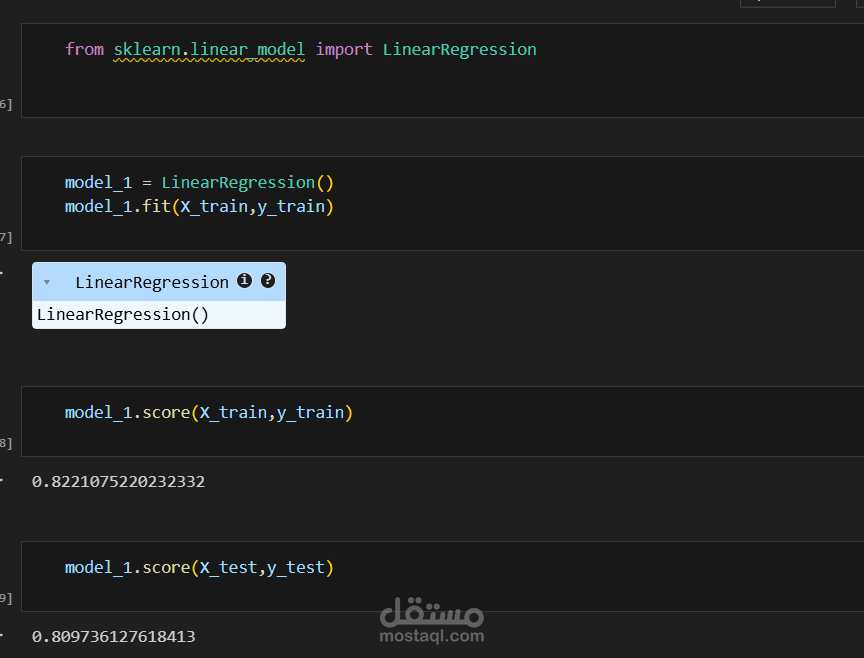
Following preprocessing, the data is split into training and testing sets, with 70% of the data used to train the model and the remaining 30% reserved to evaluate its performance on unseen data, a practice that helps validate the model's ability to generalize. The core of the project lies in the model building and evaluation phase. Two regression models are implemented: a standard Linear Regression model, which establishes a baseline by fitting a linear relationship between the features and MPG, and a Lasso Regression model, which introduces regularization (L1 penalty) to prevent overfitting by shrinking less important feature coefficients towards zero. The Linear Regression model demonstrates strong performance, achieving R-squared scores of approximately 0.82 on both training and test data, indicating a good fit and strong predictive power with minimal overfitting. Its performance is further quantified using the Mean Squared Error (MSE) metric. Finally, the project showcases the model's utility by making a prediction on a single, new data point, illustrating how the trained model could be deployed to estimate the MPG of a vehicle based on its specifications.