data analysis
تفاصيل العمل
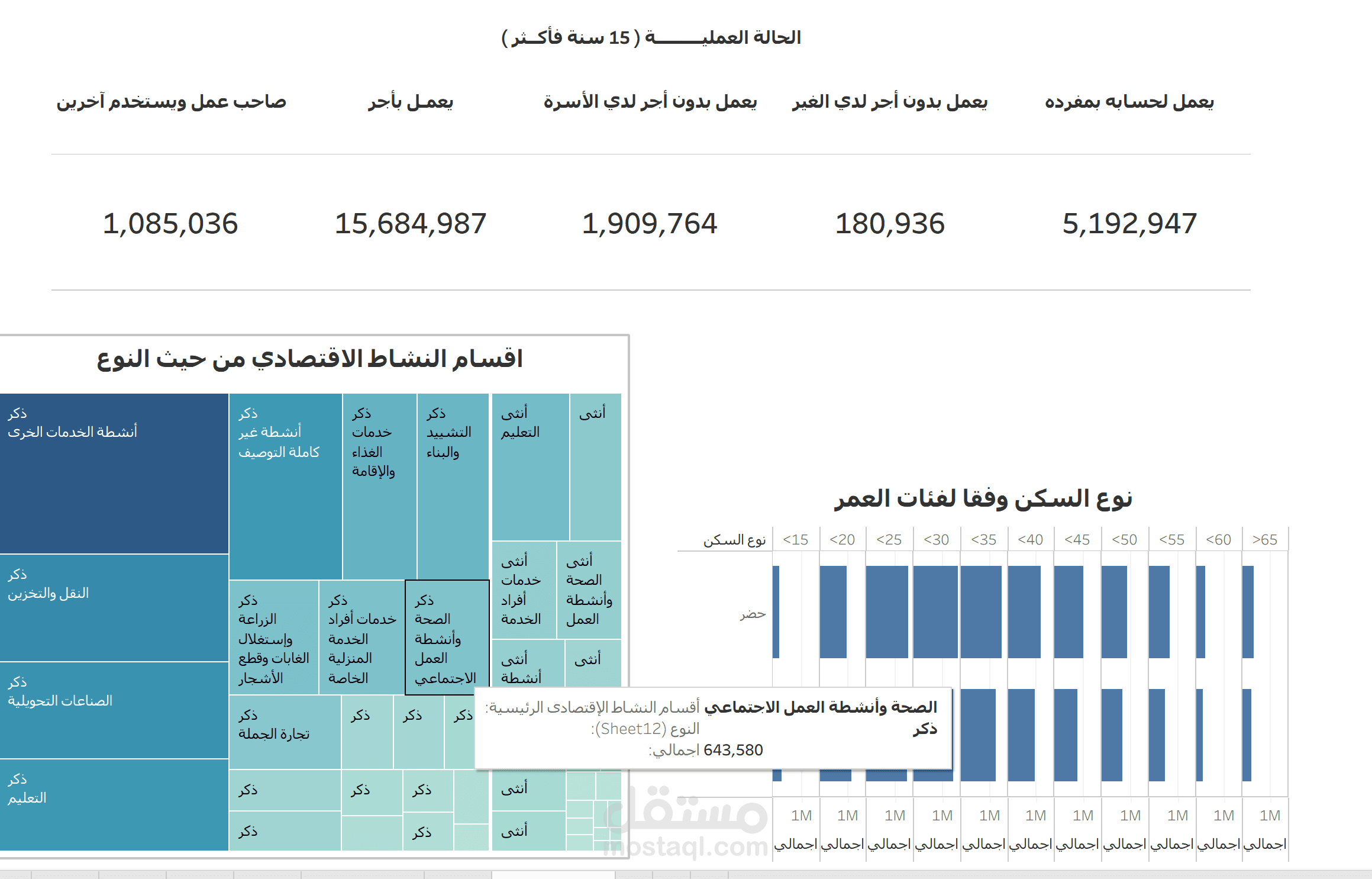
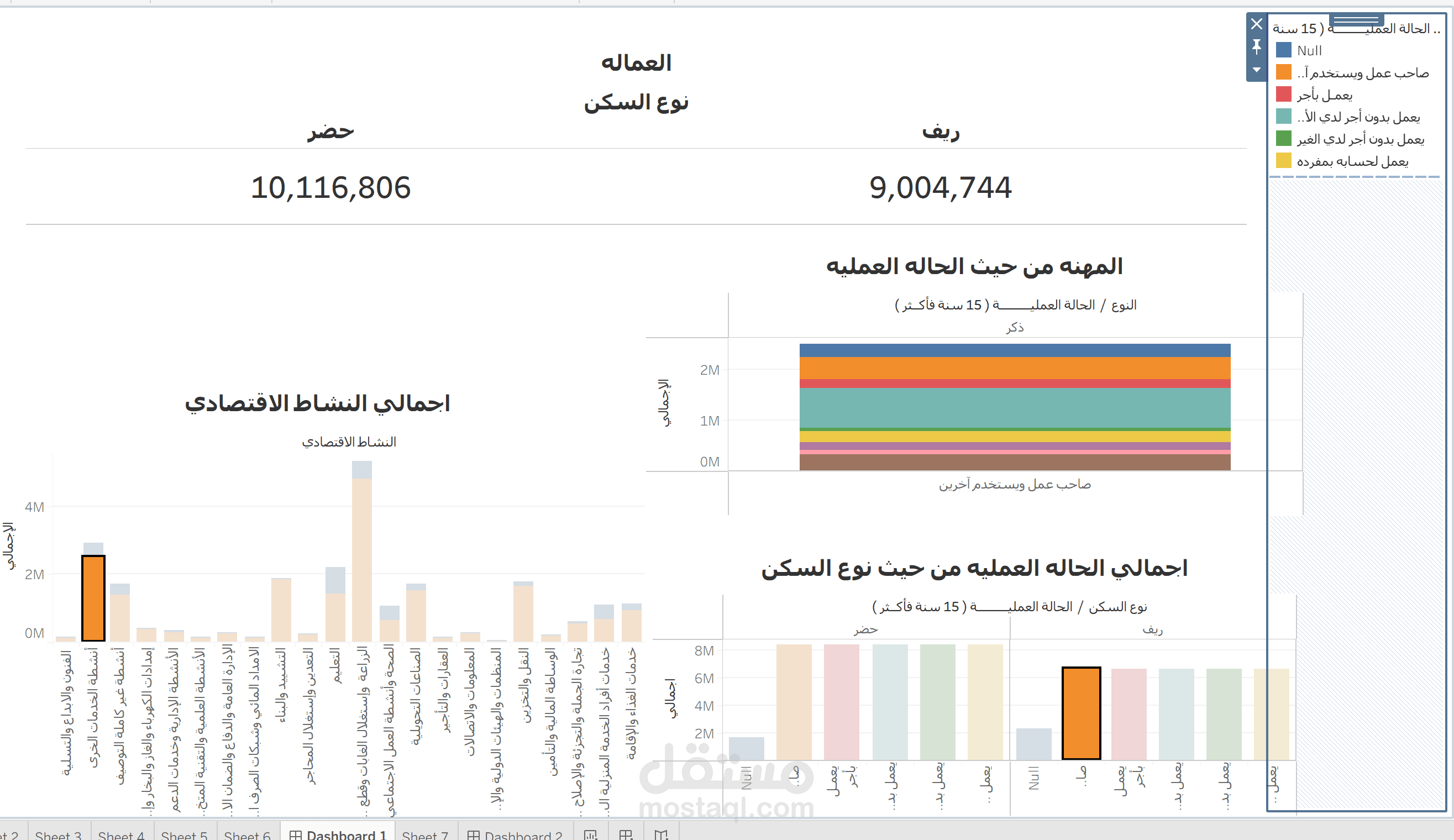
The dashboard is titled around labor distribution (“العمالة”) and distinguishes between two main categories of residence:
Urban (حضر): 10,116,806 workers
Rural (ريف): 9,004,744 workers
These figures represent the total number of working individuals aged 15 and above (“الحالة العملية (15 سنة فأكثر)”), divided according to their area of residence.
Top Section — Summary Indicators
At the top, two large numeric indicators summarize:
Urban workforce (حضر) — 10.12 million individuals
Rural workforce (ريف) — 9.00 million individuals
These headline figures provide an at-a-glance view of the population engaged in economic activities across residential categories.
Middle Section — Employment Status by Occupation
The horizontal bar chart on the right, titled:
"المهنة من حيث الحالة العملية"
(Occupation by employment status), illustrates the distribution of employment categories among males aged 15 and above.
Each color in the stacked bars represents a distinct employment status, such as:
صاحب عمل ويستخدم آخرين (Employer and employs others)
يعمل آخر (Employee)
يعمل بدون أجر لدى الأسرة (Unpaid family worker)
يعمل لحسابه بمفرده (Self-employed)
يعمل بدون أجر لدى غير الأسرة (Unpaid non-family worker)
The visual shows that the largest portion of workers fall under the “Employer and employs others” category, with relatively balanced representation across other employment types.
Bottom Left — Economic Activity Distribution
The vertical bar chart labeled "إجمالي النشاط الاقتصادي" (Total Economic Activity) displays how the workforce is distributed across different economic sectors.
Sectors include:
الزراعة وصيد الأسماك (Agriculture and Fishing)
الصناعة والتعدين (Industry and Mining)
التعليم (Education)
الإدارة والدفاع والخدمات الاجتماعية (Administration, Defense, and Social Services)
التجارة والأعمال الحرة (Trade and Freelance Work)
النقل والاتصالات (Transport and Communications)
From the chart, it is evident that trade and freelance work show the highest employment volume, exceeding 4 million individuals, followed by industry and education, while sectors like mining and public administration employ smaller portions of the workforce.
Bottom Right — Employment Status by Residence Type
The bar chart at the bottom right, titled
"إجمالي الحالة العملية من حيث نوع السكن"
(Total employment status by residence type), compares employment categories between urban and rural populations.
Each column corresponds to a specific employment type for individuals aged 15 and above, showing how each status (employer, employee, self-employed, unpaid worker, etc.) varies between urban (حضر) and rural (ريف) residents.
The data highlights minor variations, suggesting relatively even distribution, though certain job categories—such as employees (يعمل آخر)—appear slightly higher in urban settings.
Filters and Interactivity
On the right-hand side, a filter panel enables users to interact with the dataset by selecting:
Employment status categories (e.g., صاحب عمل، يعمل لحسابه، يعمل بدون أجر).
Possibly demographic or geographic variables (the filter title “الحالة العملية (15 سنة فأكثر)” indicates segmentation by working-age individuals).
This interactivity allows analysts to explore relationships between residence type, employment status, and economic sector more precisely.
Analytical Insights
Urban and rural populations have nearly comparable labor participation, with a slight urban predominance (~1.1 million more).
Employers and employees constitute the largest segments of the workforce.
Trade and freelance activities are the dominant economic sectors, indicating a robust entrepreneurial or informal economy.
Employment distribution by residence type is fairly balanced, suggesting that both urban and rural regions contribute significantly to the overall labor market.
Design and Presentation
The dashboard uses a clean, minimalist design with clear Arabic typography and color-coded bars to differentiate categories. The layout is logically structured — summary indicators on top, categorical details in the middle, and distribution analyses at the bottom — which enhances readability and data-driven storytelling.