Active satellites in orbit Around Earth (July 2016)
تفاصيل العمل
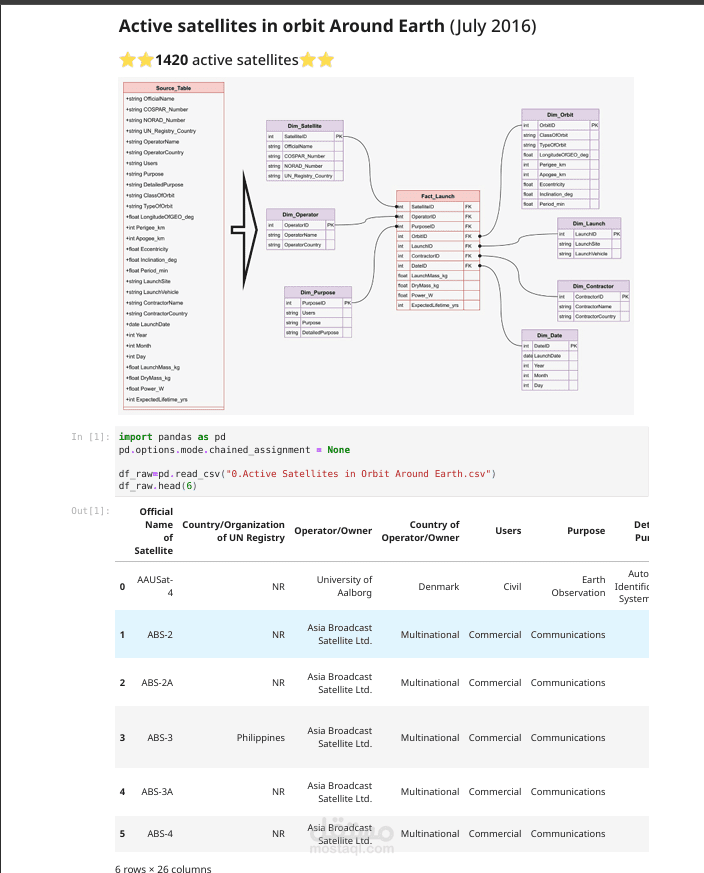
task involved transforming a complex dataset of over 1,400 active satellites in Earth's orbit into a clean, structured, and query-ready format.
we took a raw CSV file and engineered it into a powerful Star Schema data model, preparing it for BI and analytics.
Here’s a breakdown of the full ETL process:
● 1| Data Extraction & Initial Assessment
Loaded the raw satellite data using Pandas.
Conducted an initial analysis (.info(), .describe()) to understand the data types, null values, and potential inconsistencies across 26 columns.
● 2| Data Cleaning & Transformation
Duplicate & Null Handling: Ensured data integrity by checking for duplicate records and strategically handling null values in critical metric columns.
Data Type Conversion: Corrected data types for columns like Period (Minutes) and Launch Mass from 'object' to numerical types and converted Date of Launch into a proper datetime format.
Feature Engineering: Extracted Year, Month, and Day from the launch date to create useful features for time-based analysis.
● 3| Data Modeling (Star Schema)
Designed and created seven Dimension Tables to hold descriptive, categorical data:
Dim_Satellite
Dim_Operator
Dim_Purpose
Dim_Orbit
Dim_Launch
Dim_Contractor
Dim_Date
Created a central Fact Table (Fact_Launch) containing foreign keys from each dimension and the core numerical measures (e.g., Launch Mass, Power, Lifetime).
● 4| Loading the Final Tables
Merged the newly created dimension keys back into the main dataframe.
Exported each dimension and the final fact table into separate, clean CSV files, ready for loading into a data warehouse.
This project was a fantastic hands-on experience in applying fundamental data engineering principles to turn messy data into a valuable asset. It highlights how a solid data model is the backbone of any reliable analytics solution.