Secure bi lock system
تفاصيل العمل
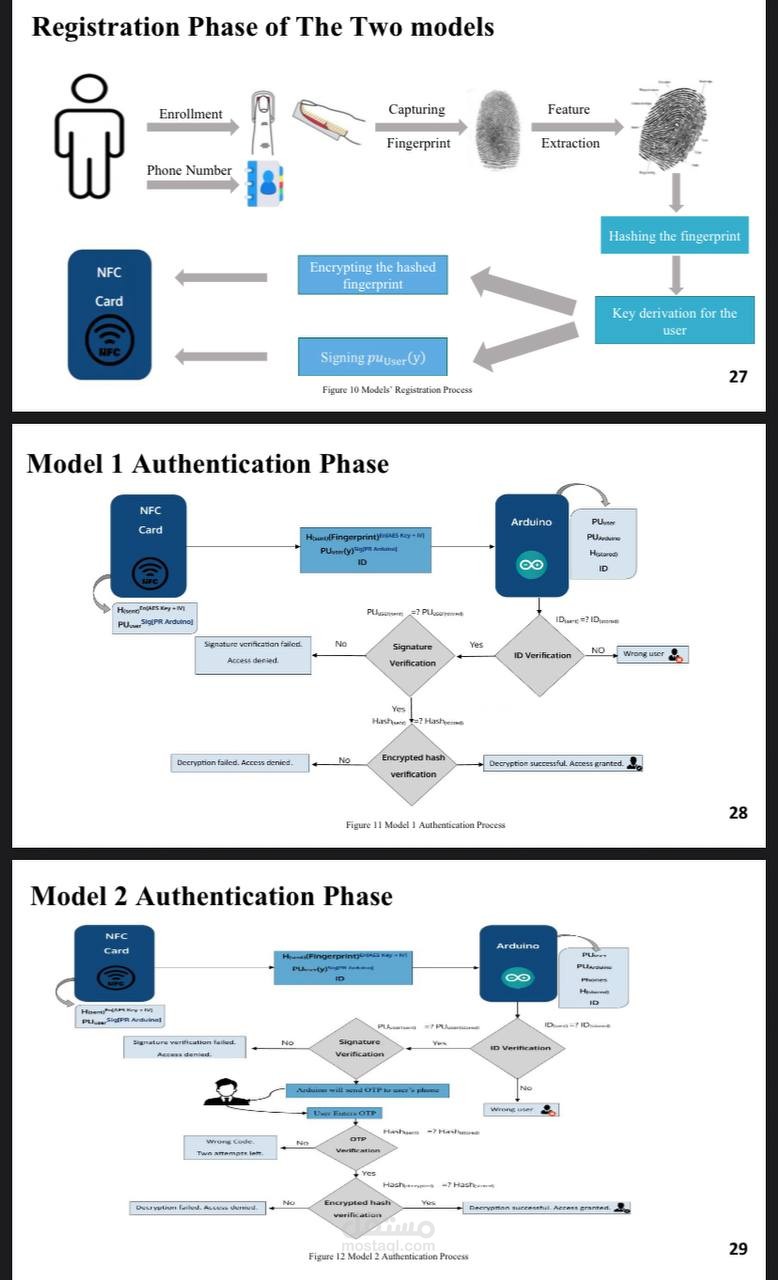
The Smart Secure Bio-Lock System Based on Sensing Methodology is a graduation project designed to enhance security and convenience through advanced biometric and cryptographic technologies. The system combines fingerprint recognition with NFC (Near Field Communication) and cryptographic algorithms to create a highly secure and user-friendly locking mechanism.
Objective
The main goal of this project is to develop a smart biometric lock system that ensures authentication, confidentiality, integrity, and non-repudiation using modern encryption and hashing techniques.
System Overview
The system integrates:
•Biometric Fingerprint Sensor for identity verification.
•NFC communication for data exchange between the user’s card and the Arduino controller.
•Elliptic Curve Cryptography (ECC) for key generation and exchange.
•SHA-512 for hashing user data securely.
•AES-256 encryption for ensuring data confidentiality.
•Digital Signature Algorithm (DSA) for message authentication and integrity verification.
Two operational models were developed:
1.Model 1: Authentication without OTP verification.
2.Model 2: Authentication with OTP verification for higher security.
Methodology
The project followed a structured development process:
1.Data Collection: Selecting and preparing biometric data.
2.System Development: Writing and testing embedded C code on Arduino.
3.Simulation and Testing: Evaluating system performance, encryption efficiency, and resistance to common cyberattacks.
Security Features
The system effectively mitigates common attacks such as:
•Eavesdropping attacks – through limited access attempts and encrypted communication.
•Replay attacks – by using OTP verification.
•Denial-of-service attacks – via card shielding mechanisms.
•Modification attacks – by applying digital signatures.
Results
Testing demonstrated strong performance in:
•Fast processing and key generation times.
•Low channel overhead (around 1056–1104 bits).
•Secure authentication with minimal execution delays.
Applications
The system has dual applicability:
•Military Use: Secure access control for restricted areas.
•Civilian Use: Smart home locks, financial transactions, and medical department security systems.