Bank_Churn_classification_ML-ANN
تفاصيل العمل
Bank Churn Classification using Machine Learning & Artificial Neural Networks (ML & ANN)
Project Description:
This project aims to predict customer churn in a bank using various classification techniques, including traditional Machine Learning (ML) models and Artificial Neural Networks (ANNs). Customer churn refers to when a customer stops doing business with the bank, and predicting churn helps financial institutions take proactive steps to retain valuable clients.
Objectives:
Analyze bank customer data to identify patterns related to churn behavior.
Build and compare different classification models including:
Logistic Regression
Decision Tree
Random Forest
Support Vector Machine (SVM)
K-Nearest Neighbors (KNN)
XGBoost
AdaBoost
Artificial Neural Network (ANN)
Evaluate model performance using metrics such as accuracy, precision, recall, F1-score, and ROC-AUC.
Use insights to understand key factors contributing to churn.
Key Features:
Data preprocessing (handling missing values, encoding categorical variables, feature scaling)
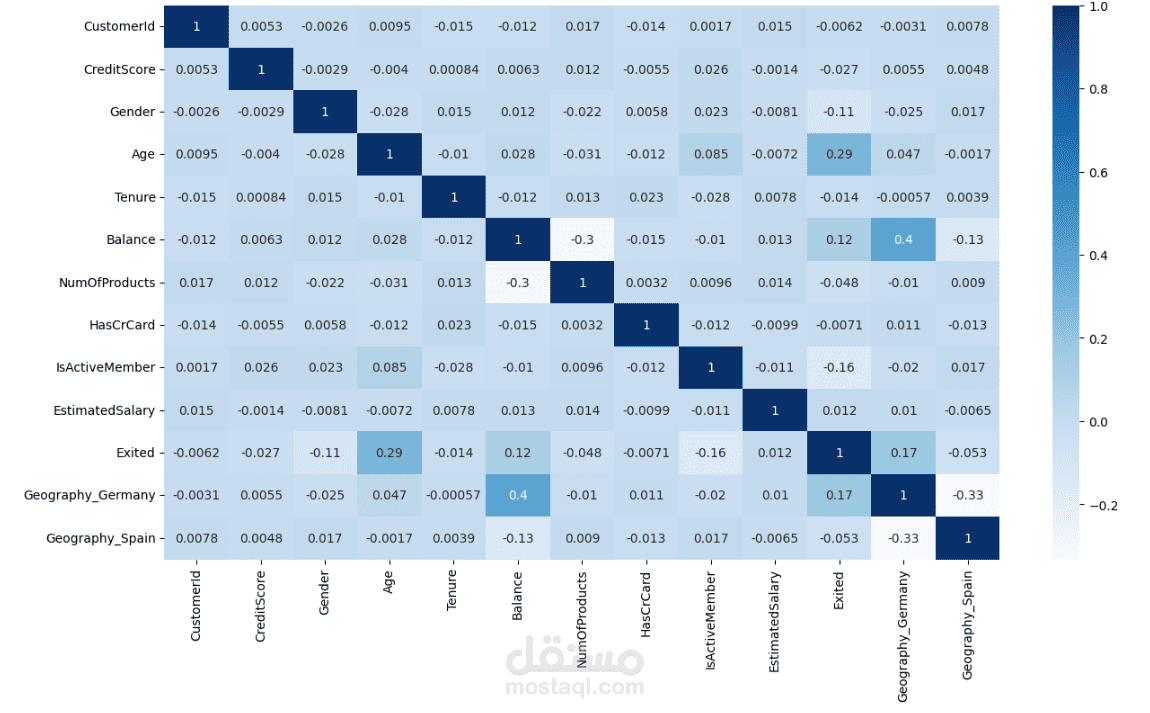
Exploratory Data Analysis (EDA) with visualizations
Hyperparameter tuning for model optimization
ANN built using TensorFlow/Keras for deep learning classification
Comparison of model performance to identify the most effective approach
Tools & Technologies:
Python (NumPy, Pandas, Scikit-learn, Matplotlib, Seaborn)
TensorFlow / Keras
Jupyter Notebook / Google Colab
Outcome:
A robust and interpretable churn prediction system that helps banks reduce customer attrition and enhance customer relationship strategies.