between tow walls
تفاصيل العمل
The In-Between Space: The House of Interstices
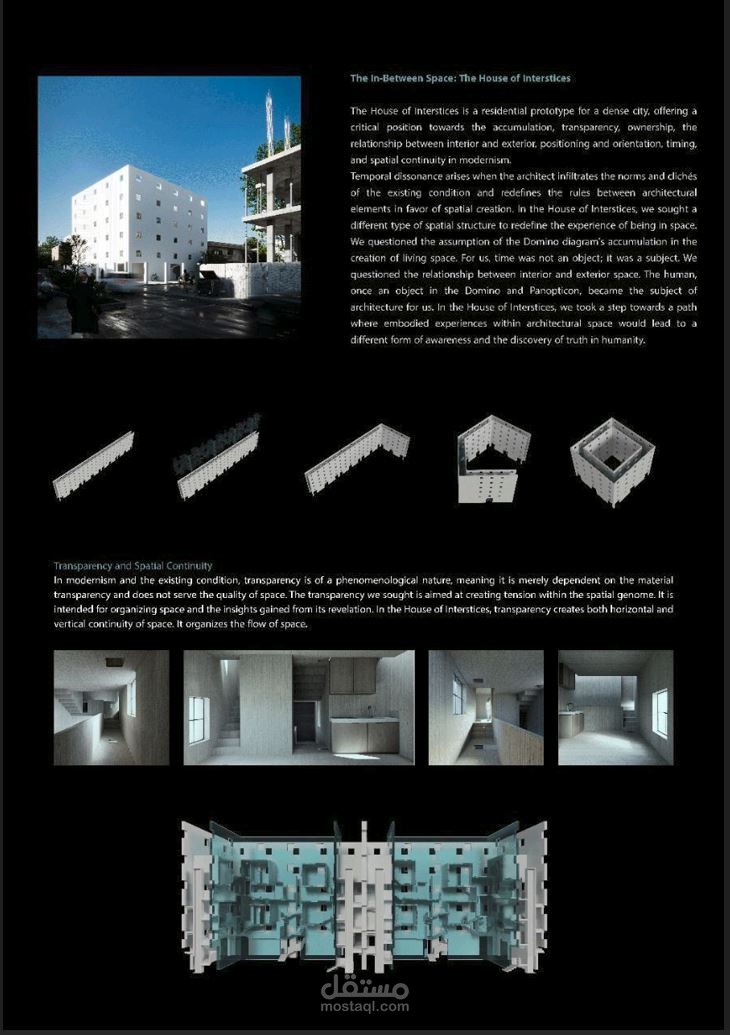
The House of Interstices is a residential prototype for a dense city, offering a critical position towards the accumulation, transparency, ownership, the relationship between interior and exterior, positioning and orientation, timing, and spatial continuity in modernism.
Temporal dissonance arises when the architect infiltrates the norms and clichés of the existing condition and redefines the rules between architectural elements in favor of spatial creation. In the House of Interstices, we sought a different type of spatial structure to redefine the experience of being in space. We questioned the assumption of the Domino diagram's accumulation in the creation of living space. For us, time was not an object; it was a subject. We questioned the relationship between interior and exterior space. The human, once an object in the Domino and Panopticon, became the subject of architecture for us. In the House of Interstices, we took a step towards a path where embodied experiences within architectural space would lead to a different form of awareness and the discovery of truth in humanity.
Transparency and Spatial Continuity
In modernism and the existing condition, transparency is of a phenomenological nature, meaning it is merely dependent on the material transparency and does not serve the quality of space. The transparency we sought is aimed at creating tension within the spatial genome. It is intended for organizing space and the insights gained from its revelation. In the House of Interstices, transparency creates both horizontal and vertical continuity of space. It organizes the flow of space.
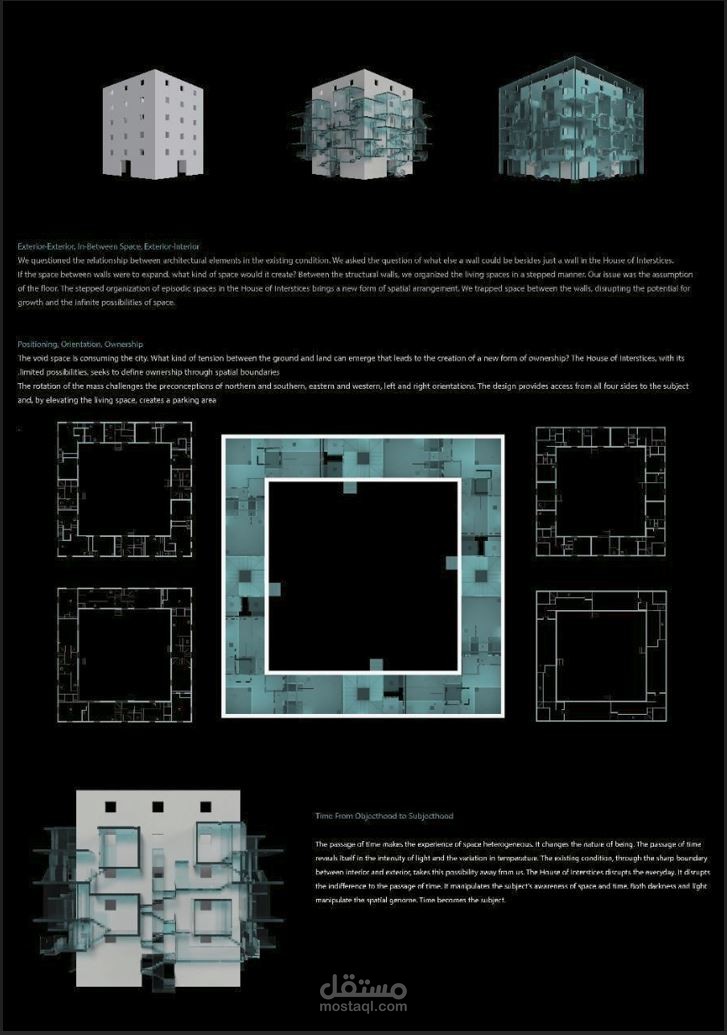
Exterior-Exterior, In-Between Space, Exterior-Interior
We questioned the relationship between architectural elements in the existing condition. We asked the question of what else a wall could be besides just a wall in the House of Interstices.
If the space between walls were to expand, what kind of space would it create? Between the structural walls, we organized the living spaces in a stepped manner. Our issue was the assumption of the floor. The stepped organization of episodic spaces in the House of Interstices brings a new form of spatial arrangement. We trapped space between the walls, disrupting the potential for growth and the infinite possibilities of space.
Positioning, Orientation, Ownership
(Junk space) – The void space is consuming the city. What kind of tension between the ground and land can emerge that leads to the creation of a new form of ownership? The House of Interstices, with its limited possibilities, seeks to define ownership through spatial boundaries.
The rotation of the mass challenges the preconceptions of northern and southern, eastern and western, left and right orientations. The design provides access from all four sides to the subject and, by elevating the living space, creates a parking area (which is a requirement of the new lifestyle).
From Objecthood to Subjecthood (The Praise of Darkness)
The passage of time makes the experience of space heterogeneous. It changes the nature of being. The passage of time reveals itself in the intensity of light and the variation in temperature. The existing condition, through the sharp boundary between interior and exterior, takes this possibility away from us. The House of Interstices disrupts the everyday. It disrupts the indifference to the passage of time. It manipulates the subject's awareness of space and time. Both darkness and light manipulate the spatial genome. Time becomes the subject.
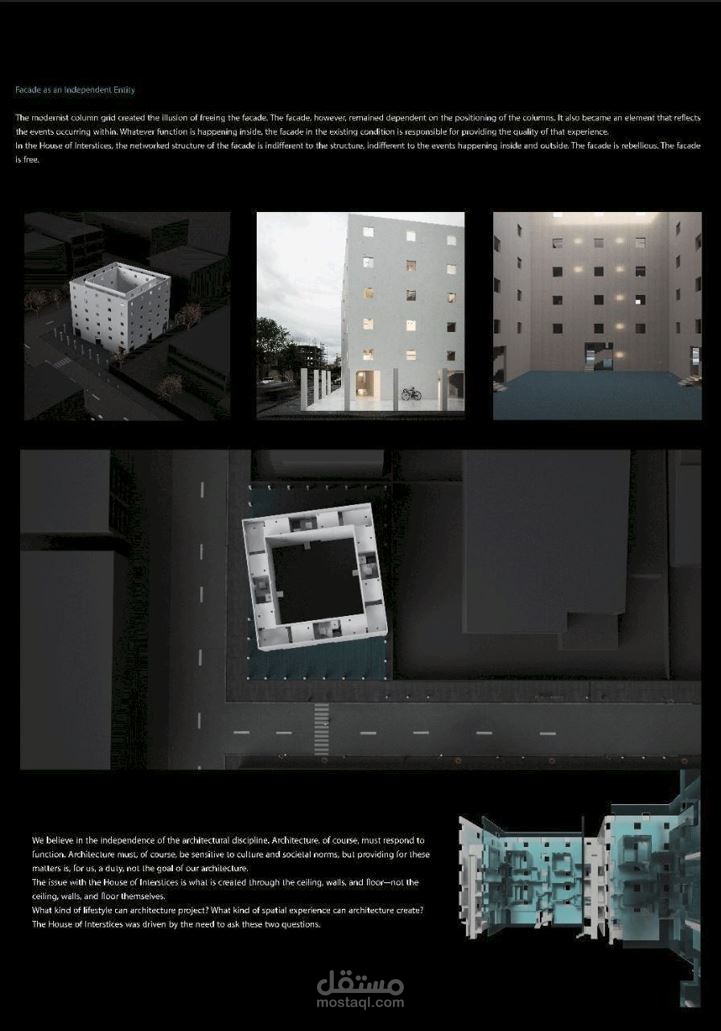
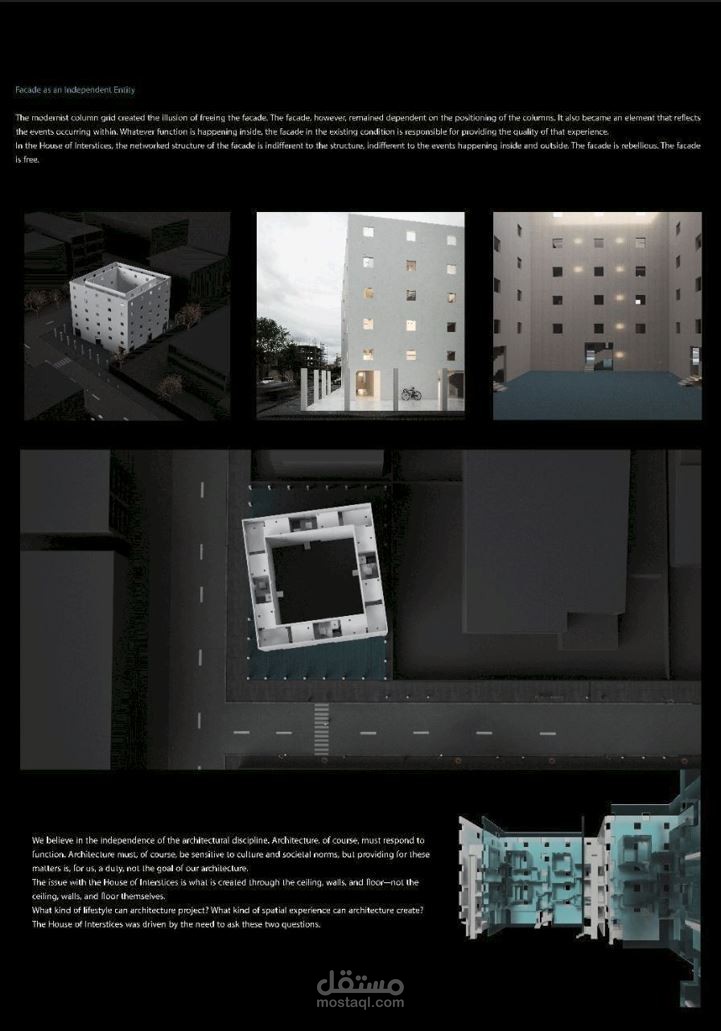
Facade as an Independent Entity
The modernist column grid created the illusion of freeing the facade. The facade, however, remained dependent on the positioning of the columns. It also became an element that reflects the events occurring within. Whatever function is happening inside, the facade in the existing condition is responsible for providing the quality of that experience.
In the House of Interstices, the networked structure of the facade is indifferent to the structure, indifferent to the events happening inside and outside. The facade is rebellious. The facade is free.
We believe in the independence of the architectural discipline. Architecture, of course, must respond to function. Architecture must, of course, be sensitive to culture and societal norms, but providing for these matters is, for us, a duty, not the goal of our architecture.
The issue with the House of Interstices is what is created through the ceiling, walls, and floor—not the ceiling, walls, and floor themselves.
What kind of lifestyle can architecture project? What kind of spatial experience can architecture create?
The House of Interstices was driven by the need to ask these two questions.