Heavy_water (D₂O)
تفاصيل العمل
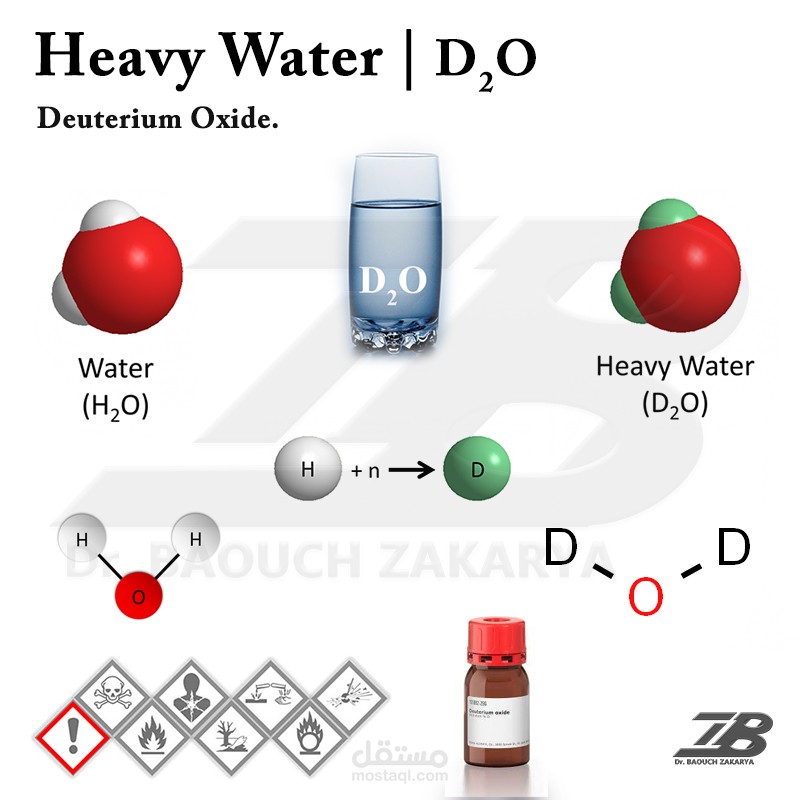
#Heavy_water (D₂O), also called deuterium oxide, is a form of water in which the usual hydrogen atoms (H) are replaced by deuterium (D), a heavier version of hydrogen. Unlike regular hydrogen, which has only a proton, deuterium has both a proton and a neutron, making it twice as heavy. Because of this, heavy water has a molar mass of about 20 g/mol, whereas ordinary water, which contains regular hydrogen, has a molar mass of about 18 g/mol.
Ordinary water from natural sources contains approximately one deuterium atom for every 6,760 hydrogen atoms. When water undergoes electrolysis (a process that uses electricity to separate hydrogen and oxygen) regular hydrogen is removed first, leaving water enriched in deuterium. By continuing this process on a large scale, nearly pure deuterium oxide can be obtained.
Until 1943, electrolysis was the primary method for producing heavy water. This process used electricity to separate hydrogen and oxygen, gradually increasing the concentration of heavy water as lighter hydrogen was removed. However, electrolysis was costly and inefficient, so it was later replaced by fractional distillation, a more economical method. In this process, water is gradually heated, and since heavy water has a slightly higher boiling point than regular water, it evaporates more slowly. As a result, heavy water becomes more concentrated in the remaining liquid.
The heavy water produced is mainly used in nuclear power plants as a neutron moderator, slowing down neutrons to sustain controlled nuclear reactions. This makes it essential for certain types of reactors. In scientific research, heavy water serves as an isotopic tracer, allowing scientists to track chemical and biochemical reactions by replacing regular hydrogen with deuterium and observing how molecules behave.