Spotify songs analysis
تفاصيل العمل
Overview With the vast amount of music available on Spotify, analyzing song features can provide insights into trends, genres, and user preferences. This project aims to analyze Spotify songs using various data attributes such as tempo, energy, danceability, and more to uncover patterns and trends in music consumption and production.
Features Data Collection: Extracting song data from the Spotify API, including attributes like tempo, energy, danceability, valence, and more. Data Preprocessing: Cleaning and normalizing the data for analysis. Exploratory Data Analysis (EDA): Visualizing and understanding the distribution and relationships of song attributes. Trend Analysis: Identifying trends in music over time, across genres, and among popular songs. Clustering and Classification: Grouping songs into clusters based on their attributes and building classification models to predict genres or popularity. Recommendation System: Developing a system to recommend songs based on user preferences and song attributes. Data The dataset includes a wide range of song attributes extracted from the Spotify API. Each song entry contains information such as track name, artist, album, release date, tempo, energy, danceability, valence, and more.
Usage Data Collection:
Use the Spotify API to fetch song data. Store the data in a structured format (e.g., CSV, database). Data Preprocessing:
Clean the dataset to handle missing values and inconsistencies. Normalize numerical attributes for uniform analysis. Exploratory Data Analysis (EDA):
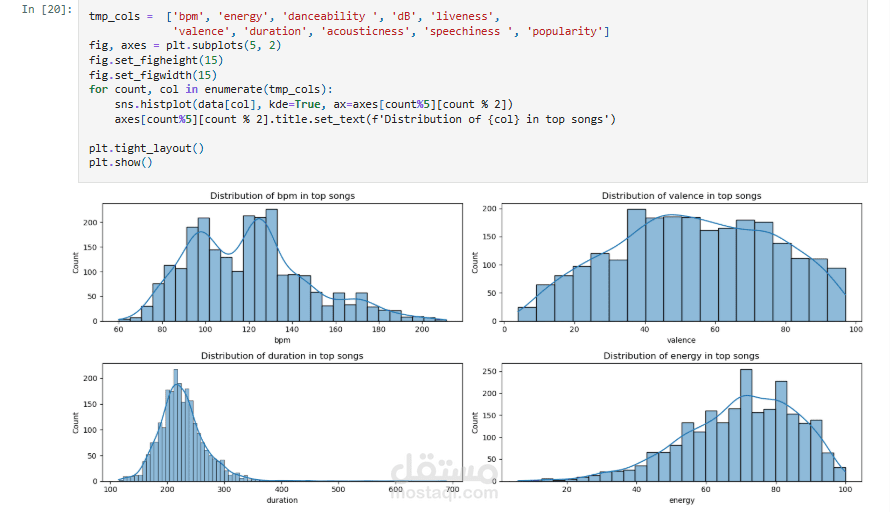
Visualize the distribution of song attributes. Identify correlations and relationships between different attributes. Analyze trends over time and across genres. Trend Analysis:
Use time series analysis to identify trends in music attributes. Compare trends across different genres and popularity levels. Clustering and Classification: