Concrete Compressive Strength Prediction Using Deep Learning
تفاصيل العمل
Project Overview: This project leverages advanced machine learning techniques to predict the compressive strength of concrete mixtures based on their ingredient proportions and curing age. Utilizing a dataset provided by Cognitive Class—an educational initiative by IBM—this model serves as a critical tool in optimizing concrete formulations for construction projects, ensuring durability and structural integrity.
Data Description: The dataset encompasses multiple variables that influence the strength of concrete, including:
Cement
Blast Furnace Slag
Fly Ash
Water
Superplasticizer
Coarse Aggregate
Fine Aggregate
Age
These features serve as predictors in the neural network model, with the target variable being the 'Strength' of the concrete, which is a measure of its ability to withstand loads without failing.
Functionality:
Data Preparation:
Data Loading: The concrete data is loaded from a publicly accessible CSV file, ensuring transparency and reproducibility.
Data Splitting: The dataset is divided into predictors (input features) and the target variable (compressive strength), preparing it for model training.
Model Construction:
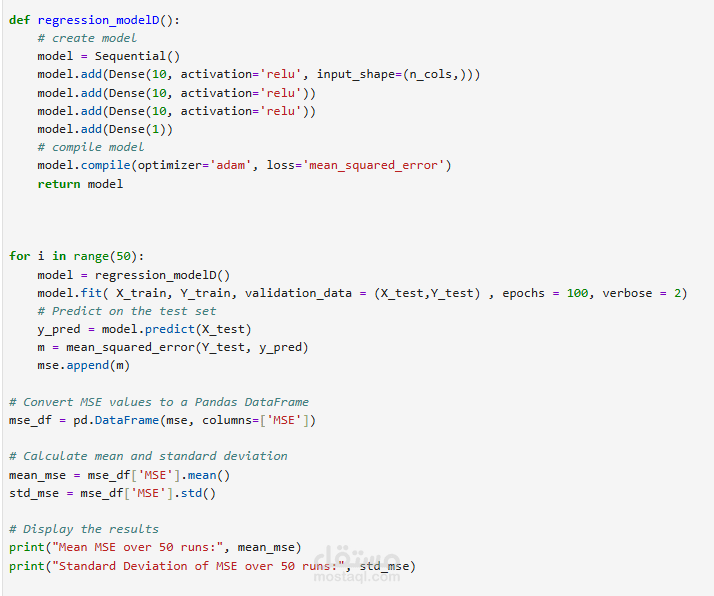
Architecture: A neural network is constructed using Keras, featuring multiple dense layers with ReLU activation for nonlinear processing and a linear output layer for predicting the compressive strength.
Model Training and Evaluation:
Training Process: The predictors and target are split into training and testing sets, with the model trained over multiple epochs to minimize the mean squared error (MSE) between the predicted and actual compressive strengths.
Evaluation: Performance is quantitatively assessed using MSE, providing a clear measure of accuracy.
Performance Tracking:
Repetitive Evaluation: The model's training and evaluation are repeated 50 times to ensure consistency and reliability of the results.
Statistical Analysis: The mean and standard deviation of the MSE are calculated across all runs, offering insights into the model’s stability and potential variability in performance.
Extensions and Variations:
Normalization: Input features are normalized to test whether standardizing inputs can enhance model performance.
Architectural Adjustments: Variations in the number of training epochs and modifications to the neural network architecture (such as adding more layers) are explored to identify potential improvements in predictive accuracy.
Impact and Applications: This project provides a practical application of machine learning in the field of civil engineering, where accurately predicting the strength of concrete can significantly affect the safety, cost-efficiency, and environmental impact of construction projects. By enabling more precise concrete formulations that meet specific strength requirements, the project helps in reducing material wastage and improving overall construction quality.
Conclusion: The ability to predict concrete strength with high accuracy through machine learning not only enhances construction practices but also paves the way for innovations in materials science. This project stands as a testament to the potential of integrating AI technologies in traditional industries to drive efficiency and sustainability.