App_Store_Reviews
تفاصيل العمل
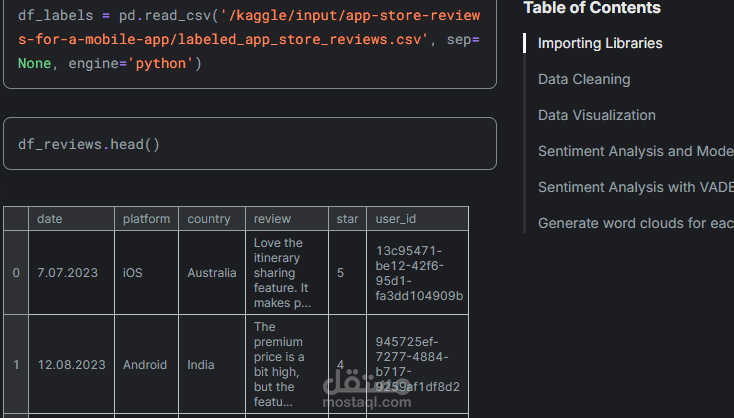
The project titled "App Store Reviews" by Mazen Ahmed on Kaggle appears to focus on analyzing app reviews from the App Store. This type of project typically involves exploring user feedback, sentiment analysis, and identifying patterns or trends in app ratings and reviews. Below is a summary of what such a project might entail:
Project Overview:
Dataset Description :
The dataset likely contains reviews and ratings for apps available on the App Store. Common features in such datasets include:
App name
User reviews (text)
Ratings (e.g., 1 to 5 stars)
Review date
User location (optional)
App category (e.g., Games, Productivity, Social Networking)
Objective :
The primary goal of the project could be to:
Analyze user reviews to understand customer sentiment.
Identify common themes or issues mentioned in reviews.
Predict app ratings based on review text.
Explore factors that influence user satisfaction or dissatisfaction.
Data Preprocessing :
This step typically involves:
Cleaning the review text (removing special characters, stop words, etc.).
Handling missing values in ratings or other fields.
Tokenizing and vectorizing text data for machine learning models.
Splitting the dataset into training and testing sets.
Exploratory Data Analysis (EDA) :
The author may have performed EDA to:
Visualize the distribution of app ratings (e.g., how many 5-star vs. 1-star reviews).
Analyze trends over time (e.g., changes in user sentiment).
Identify the most common words or phrases in positive and negative reviews.
Compare review patterns across different app categories.
Sentiment Analysis :
Sentiment analysis is often a key component of this type of project. The author might have used techniques such as:
TextBlob or VADER for rule-based sentiment analysis.
Machine learning models (e.g., Logistic Regression, Naive Bayes) trained on labeled sentiment data.
Deep learning models like LSTM or BERT for more advanced sentiment classification.
Classification Task :
A common task in this project would be to classify reviews as positive, negative, or neutral based on their text. This could involve:
Feature extraction using techniques like TF-IDF or word embeddings (e.g., Word2Vec, GloVe).
Training classification models (e.g., Random Forest, Gradient Boosting, Neural Networks).
Regression Task :
Another possible task is predicting the rating (numerical value) of an app based on its review text. This could involve:
Using regression algorithms like Linear Regression, Decision Trees, or XGBoost.
Evaluating performance using metrics like Mean Absolute Error (MAE) or Root Mean Squared Error (RMSE).
Key Insights :
The project likely includes insights such as:
Common reasons for high or low ratings (e.g., bugs, poor performance, lack of features).
Differences in user sentiment across app categories.
Trends in user feedback over time (e.g., increasing complaints about ads).
Most frequently mentioned keywords or topics in reviews.
Visualization :
The author may have created visualizations such as:
Word clouds to highlight frequent terms in reviews.
Bar charts showing the distribution of ratings.
Line graphs to track sentiment trends over time.
Heatmaps to show correlations between features.
Applications :
The results of this project could have practical applications in:
Improving app development by addressing user concerns.
Enhancing marketing strategies based on user preferences.
Automating review moderation and sentiment monitoring.
Providing actionable insights to app developers and businesses.
Conclusion :
The project concludes with key findings, limitations, and suggestions for future work. It may also emphasize the importance of understanding user feedback to improve app quality and user experience.