classification report about NYC
تفاصيل العمل
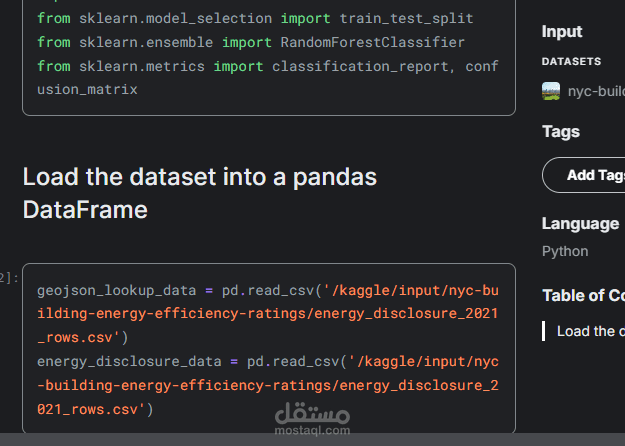
The project titled "Classification Report about NYC" by Mazen Ahmed on Kaggle appears to focus on applying classification techniques to a dataset related to New York City (NYC). While I don't have direct access to the specific code or dataset, I can provide a general summary based on typical projects in this domain.
Project Overview:
Dataset Description :
The dataset likely contains information about various aspects of NYC, such as:
Crime rates and types.
Demographic data (e.g., population density, income levels).
Transportation data (e.g., subway usage, traffic patterns).
Real estate data (e.g., housing prices, rental trends).
Environmental data (e.g., air quality, weather conditions).
The exact nature of the dataset would determine the classification task being performed.
Objective :
The primary goal of the project could be to:
Build a classification model to predict a target variable based on the dataset's features.
Evaluate the performance of different classification algorithms.
Generate insights into the factors influencing the target variable.
Classification Task :
Possible classification tasks could include:
Predicting crime categories (e.g., theft, vandalism) based on location and time.
Classifying neighborhoods into groups based on socioeconomic indicators.
Identifying transportation modes (e.g., subway, bus, car) based on user behavior.
Categorizing real estate listings as affordable or expensive.
Data Preprocessing :
This step typically involves:
Cleaning the data (handling missing values, removing duplicates).
Encoding categorical variables (e.g., converting text labels into numerical values).
Normalizing or scaling numerical features for better model performance.
Splitting the dataset into training and testing sets.
Exploratory Data Analysis (EDA) :
The author may have performed EDA to:
Visualize distributions of key variables.
Identify correlations between features and the target variable.
Detect outliers or anomalies in the data.
Machine Learning Models :
Common classification algorithms that might have been used include:
Logistic Regression
Decision Trees
Random Forests
Support Vector Machines (SVM)
K-Nearest Neighbors (KNN)
Gradient Boosting Algorithms (e.g., XGBoost, LightGBM)
Evaluation Metrics :
The performance of the classification models is typically evaluated using metrics such as:
Accuracy
Precision
Recall
F1-Score
Confusion Matrix
ROC-AUC Curve
Results and Insights :
The project likely includes:
A comparison of the performance of different models.
Identification of the most important features influencing the target variable.
Discussion of potential real-world applications of the classification model.
Applications :
Depending on the dataset and classification task, the results could have practical applications in:
Urban planning (e.g., optimizing public services).
Public safety (e.g., predicting crime hotspots).
Transportation management (e.g., improving traffic flow).
Real estate analysis (e.g., identifying investment opportunities).
Conclusion :
The project concludes with key findings, limitations, and suggestions for future work. It may also emphasize the importance of leveraging machine learning for solving urban challenges.