PassGenPro
تفاصيل العمل
You're right! The GUI (Graphical User Interface) feature isn't explicitly mentioned in the previous essay. Let me provide an updated version that includes it.
The Password Profiling Tool, inspired by the CUPP (Common User Passwords Profiler) project, is a Python-based application designed to generate personalized password lists. This tool is particularly useful for ethical hacking, penetration testing, and learning about password security practices. By leveraging user-provided personal information, the tool creates tailored wordlists that mimic the way people often craft passwords using details from their lives.
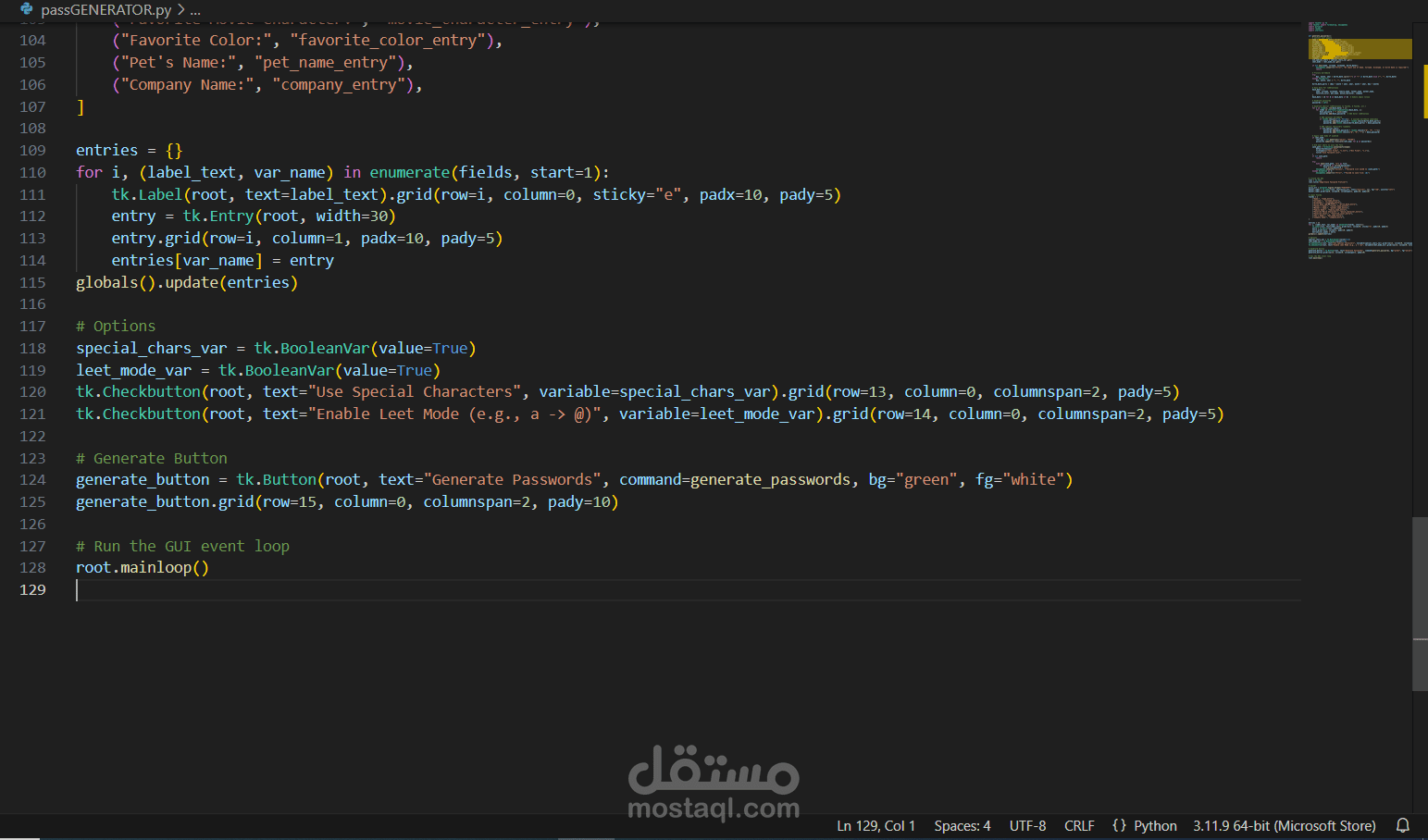
What makes this tool even more user-friendly is its Graphical User Interface (GUI). The GUI allows users to easily input their data such as names, nicknames, birthdates, parents' names, and even favorite colors through simple text fields and checkboxes. This interface eliminates the need to interact with the program via the command line, making it accessible to a broader audience. The user enters their personal details into the various fields, and the tool generates logical combinations of these inputs to create passwords, such as combining the user's name with their birthdate or surname with their favorite color.
In addition to the basic combinations, the tool has the ability to incorporate special characters like @, #, and !, which are randomly added to the generated passwords. It also offers an optional "leet mode," where certain letters are replaced by numbers or symbols (e.g., "a" becomes "@", "e" becomes "3"). These features make the wordlists more diverse and reflective of real-world password habits.
The tool's design ensures that the generated passwords start with simpler combinations and progress to more complex ones, covering all of the provided details. Users can save the generated password list to a file of their choice, which is facilitated by a file save dialog in the GUI.
By combining the simplicity of a GUI with powerful password generation techniques, this tool emphasizes the importance of secure and diverse passwords. It showcases how easily predictable patterns based on personal information can be used to create passwords, thus highlighting the risks of using such information. The project demonstrates the versatility of Python in handling user inputs, managing string manipulation, and creating a practical and user-friendly tool for password generation.