mechanical fasteners
تفاصيل العمل
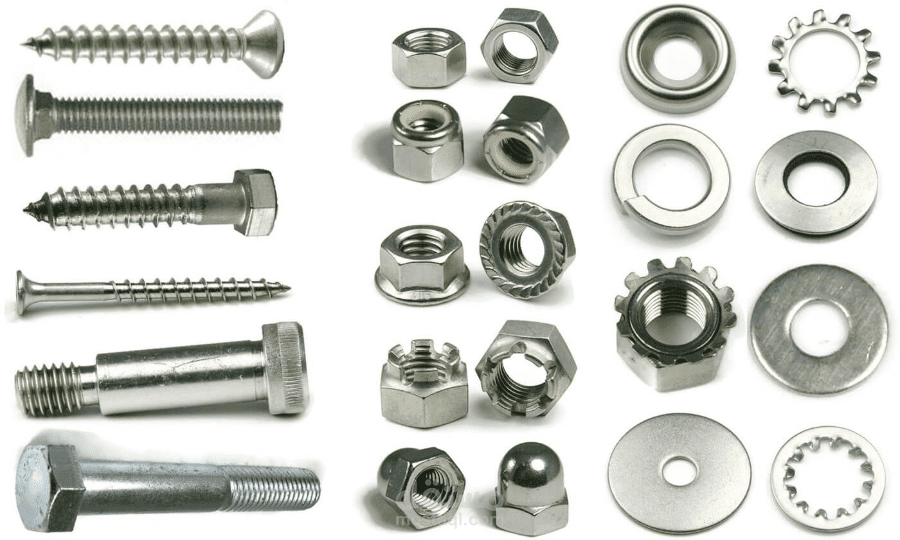
A fastener is a term describing a wide range of tools such as screws, washers, nuts, and bolts. All these tools have a common objective of holding two or more objects mechanically together.
Unlike glue, fasteners can secure objects made of metal, plastic, wood, and concrete. They hold together objects that can endure high levels of stress. These screws, locking washers, nuts are further categorized into socket screws, wood screws, permanent fasteners, self-tapping screws, and many more different types of fasteners and their uses
Fasteners can be classified mainly into two categories: Permanent fasteners and Non-Permanent fasteners. As their names imply, a permanent fastener forms a permanent joint and the latter, a temporary joint. This versatility of having different types of bolt heads makes them high in demand. Mechanical fasteners are commercially available in many sizes and forms. They have different types which have several categories within themselves as well. Some of the most common types of fasteners are summarized below:
· Screws: An externally threaded fastener with high durability and better grip strength
· Bolts: A partially threaded fastener that holds two parts together also called threaded bolts
· Nuts: It is internally threaded and fits into a bolt for securing objects and preventing loosening
· Rivets: It forms permanent joints between objects, also contains pop rivets
· Washers: A flat disc that is used with a nut and bolt for load distribution
· Nails: A long and thin piece of metal used for joining objects
· Anchors: it is used for fixing objects to concrete surfaces
All these types of fasteners mentioned above have further categories and relevant unique applications. Let’s dig into the details of the types of fasteners and also see what fasteners are used for.
Screws:
Screw fasteners are the most commonly used type of fasteners. They are highly versatile and durable. These socket screws have to fix eroded internal threads spanning across their whole length and their heads come in various shapes. Screws require internal threads in objects for holding them together. They make male threads into the object in which they are inserted. This reduces the need for pre-tapping.
There are many designs of screw fasteners commercially available for example machine screws, deck screws, sheet metal screws, lock nuts, lock washers, slotted headless set screws and many more. Some of these include:
· Machine screws
Machine screws are used for fastening two metallic objects. They are inserted into already threaded holes that is why machine screws sometimes are also referred to as threaded fasteners.
· Deck screws
This type of screw fastener- sometimes referred to as wood screws, has coarse threads and a tapered head. They are used in outdoor decks and wooden materials to resist corrosion.
· Sheet metal screw
These crews have sharp-cutting threads for joining metal with other objects. They can cut through sheet metals, plastics, and wood using their notched point. Sheet metal screws usually make the best bond in a nut threaded hole or tapped hole.
· Drywall screw
They have coarse threads and tapered heads with fine tips to be inserted into drywall without damaging the material.
· Hex Lag screw
These are large wood screws that are driven with a wrench instead of a screwdriver. They are used in heavy-duty applications. Hex cap screws have a hexagonal head shape, this hexagonal gripping point helps them build a greater torque. That is why these hex head bolts are known to be the strongest metal fasteners. Hex cap screw is sometimes also referred to as a wood screw.
These are some types of most common screws, now let’s jump towards the bolts, bolt head, and their types.
Bolts:
Another common type of fastener is bolts. These two pieces work together for holding unthreaded parts together. The bolt is a fastener with a straight, threaded shank and a head paired with a nut to clamp objects together. Some of the various types of bolts and nuts include:
· Carriage bolts
Carriage bolts have square necks, convex heads, and multiple threads on them which are used for fastening wooden materials.
· Allen bolts
These bolts have a hexagonal socket in their head for use with an Allen wrench
· Plow bolts
These plow bolts are the flat square head bolts, countersunk, square neck, and unified thread, plow bolts are heavy-duty fasteners.
· Flange bolts
They have a circular flange, a U bolts shape, under their head that acts as a washer for load distribution. These can be categorized as U bolts.
· Fastening anchor bolts
These anchor bolts connect non-structured and structured elements strongly with each other.
· Double End bolts
As clear from the name, double end bolts have sharp threads on both sides, hence these are used for the joining of two flanges together.
Bolts are considered as important as screws, and we have briefly defined some of their major types to elaborate their functioning.
Nuts:
An important fastener that works in pair with a bolt is a nut. It is internally threaded to fit with a bolt of the same size to improve the grip and provide increased torque. Lock Nuts are threaded in a way to an already defined nut or tapped hole. The different types of hex nuts include the following:
· Wheel nuts
Also known as lug nuts, they are used for securing the wheels of vehicles.
· Cap nuts
Socket cap nut protect internally threaded anchors of the fastener by avoiding their protrusion
· Flange nuts
Used widely in assembly lines, these nuts have a wide flange at one end. This distributes the pressure and secures the part.
· Coupling nuts
A coupling nut is an elongated jam nut for joining threaded rods. They also allow extending a rod.
Nails:
Nails are the most ancient fasteners used in history, and we still find a lot of applications that make use of nails. A nail physically appears a lot like a screw, but the difference can be easily spotted in them. One of the major differences between nails and self-tapping screws is that a nail doesn’t have machine threads on it, while a screw carries threading. No doubt a screw provides a better and strong joint, but a nail has a better shearing property, which makes it a good choice to be used in some applications.
Here we have discussed some major types of nails:
· Common nails
This category of nails has a thicker body shank, and this thick property helps it to make a stronger joint between two or more objects. One of the major disadvantages of a common nail is that its thicker shank is visible in the joint and this greatly reduces the aesthetic property of the joint parts.
· Box nails
Box nails have both a diamond point tip and head shapes tip. These are most commonly deployed in the joining of steel constructions.
· Finishing nails
Finishing nails are flat square head set screws, which when used in the applications, make them blended in the application material with a better locking mechanism. This category of smooth rounded head nails leads to a neat finish and is utilized commonly in intricate and detailed design works.
· Flooring nails
As narrated in the name, this category of nails is used in flooring applications.
· Roofing nails
Roofing nails are said to be corrosion-free nails, and these have a wide head appearance.
· Framing nails
These nails have many different manufacturing designs, often deployed in the installation of flush and associated applications. They also exhibit easy camouflage and concealment.
So, these are some important types of fasteners that have been briefly narrated above. You must be wondering that of what material these nuts, screws, bolts, and structural washers are made of. Let’s move towards the materials required for making fasteners and plain washers.
The Material Used For Making Sheet Metal Screws
The material used in the manufacturing of the mechanical fastener depends greatly on its applications. A variety of materials are used in types of fasteners, from aluminum and brass to various grades of steel. The material choice plays an important role in instilling properties such as strength, resistance to corrosion, and brittleness.
Let’s look into some commonly used materials for types of fasteners in industries.
Steel Fastener:
Steel is the most commonly used material for the manufacturing of fasteners. Around 90% of fasteners are made of steel. The reason for its popularity is the durability and strength it adds to the fasteners. They are used both as plain steel as well as steel with surface treatments like zinc plating and galvanization.